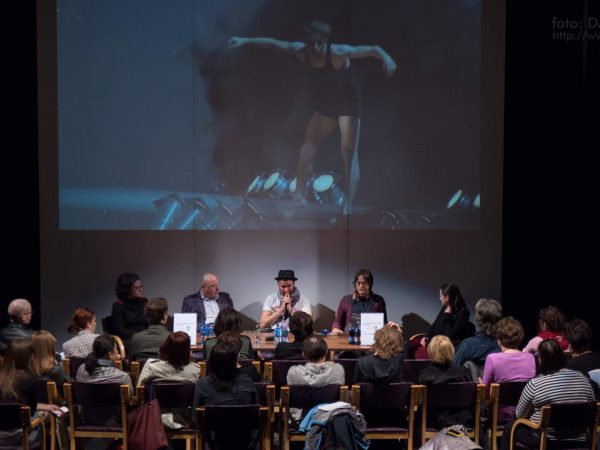
March 27 has been celebrated as World Theatre Day since 1962. The initiative was taken the year before by the International Theatre Institute (ITI), which promotes the exchange of knowledge and practices in the field of performing arts, ensures connections between artists of all nations and nationalities, and, among other things, draws attention to the importance of respecting human rights and cultural diversity.
In Slovenia, this day traditionally begins Week of Slovenian drama, this year will be the 54th edition, and the Association of Dramatic Artists of Slovenia (ZDUS) awards.
On World Theatre Day, an international message is sent around the world, written by a theatre artist selected for this purpose at the invitation of the ITI. The first message was sent to the world in 1962, and its author was Jean Cocteau. The author of this year's international message is the Norwegian writer and playwright Jon Fosse.
In addition to the international message, which is read around the world (including here) at special theatre events or before performances, many countries also celebrate World Theatre Day with national messages. This year, the Slovenian Association of Dramatic Artists asked the director Žigo Divjakto write a Slovenian message.
Slovenian message on World Theatre Day 2024

I love theatre for that wonderful, slightly sublime, gentle, giddy feeling after watching a good performance, when you feel like you're floating a little above the ground, and everything is light and somehow right, in place, even if it's tragic, sad and difficult. I love it for the euphoric excitement when, after rehearsal, most often over a beer, after hours and hours of pondering, pondering and pondering, you come up with a great idea, a solution for the performance. I love it a little less the next day, when you try out that brilliant idea at rehearsal, a flashback of the night before and... Yes... I love theatre because we fly and break our teeth and fly again and break our teeth a little more and now it may sound like we're in control, like we're used to it and aware of it, but we're not; when it hurts, it really hurts and when it feels good, it feels good. I love theatre because it is real when it is real, and I don't like it when something is half-baked. That's when I would rather close it, seal it up forever, ban it, end it. I love theatre when it turns our weaknesses, our shortcomings into our trump cards, into our strength – then it touches the beauty of life in a wonderful way; and I love it when it uncompromisingly punishes those who lazily, self-confidently count on the self-evidentness of their trump cards, their strength – then too it touches the beauty of life in a wonderful way. I love it for the funny connection, attachment, closeness that develops between a team when everything comes together, and I love it because it doesn't always come together and closeness is not self-evident and sometimes we are far from each other and don't even speak the same language. I love it for its crazy flashes, good ideas, unexpected twists, and I really don't like it when these good ideas can't be realized due to lack of resources or, worse, due to lack of understanding or will, I don't like it when it falls victim to inertia. I love theater because it trains our attention, awakens our feelings, because it reminds us that we can empathize with the most unusual people, objects, animals, creatures, because, when it's good, it reminds us that we are not eternal, that we are not alone, that we are just a small part of a big world, but despite all our mistakes and imperfections, we are still an important part, because there are simply no insignificant parts on this planet and this world would be a little less varied, a little less colorful without us. I love theater because when we surrender to it, it convinces us that someone else's problem becomes ours too. In theater, we can admit that we care, that we feel more than we show. And we feel a lot. Especially in this uncertain moment, when war is spoken of so easily, as if the words have no weight, as if all memory of what war really means has been lost. We feel a lot in this time, when politicians resemble allegorical dramatic characters more than leaders.
We feel a lot as we break heat records year after year, and we feel a lot as we helplessly watch the genocide in Gaza and wonder how this is possible, how it is possible that we are watching this live, that we know what will follow, that this follows and nothing happens.
We feel a lot.
I love theater and art gives me hope, but there is not enough hope. And as I write this letter, I seriously wonder what kind of theater will even be possible after what is happening in Gaza.
Žiga Divjak, director
International Message for World Theatre Day 2024

Art is peace
Every person is unique, yet just like everyone else. Our visible, external image is different from everyone else, of course, all well and good, but also within each of us there is something that belongs only to the individual – what that individual is in itself. We can call this the spirit or the soul. Or we can decide that it doesn't need a verbal designation at all and just leave it alone.
But even though we are different, we are also the same. People from all over the world are fundamentally similar, no matter what language we speak, what color our skin is, or what kind of hair we have.
Perhaps this is a kind of paradox: that we are completely the same and completely different at the same time. Perhaps man is a paradox in himself, by connecting body and soul - there is both in us, the most earthly, tangible existence and something that transcends material, earthly limitations.
Art, good art, has a miraculous way of combining the unique with the universal. It allows us to understand the different – the foreign, one might say – as universal. In doing so, art breaks down the boundaries between languages, geographical regions, and countries. It brings together not only what is characteristic of each of us, but also, in its own way, the characteristics of groups, such as individual nations.
It does not do this by equating everything and leveling out differences, but on the contrary, by showing us what is different from us, what is unknown to us, foreign. All good art contains precisely this: something unknown, something that we cannot fully understand, but at the same time somehow grasp. It contains, let's put it this way, a mystery. Something that astonishes us and pushes us beyond our limits, thus creating the transcendence that art must contain in itself and lead us to it.
I know of no better way to bring opposites together. It is the exact opposite of the approach of violent conflict that we witness all too often in the world, an approach that gives in to the destructive temptation to annihilate everything foreign, everything unique and different, often using the most cruel inventions that technology has brought us. There is terrorism in the world. There is war. Because humans also have an animalistic side, driven by the instinct to experience the other, the foreign, as a threat to our own existence and not as a fascinating mystery.
In this way, uniqueness – the differences that we can all see – disappears, leaving behind a collective sameness in which anything different is a threat to be erased. What appears to be difference from the outside, such as religion or political belief, becomes something to be defeated and destroyed.
War is a battle against what lies deep within us all: against the unique. And it is also a battle against art, against what lies deep within all art.
I am talking about art in general, not specifically about theater or drama, because, as I said, all good art, deep down, revolves around the same thing: making something completely unique and specific into something universal. In artistic expression, it combines the completely specific with the universal: it does not remove specificity, but emphasizes it, allowing everything that is foreign and unknown to shine through it clearly.
War and art are opposites, just as war and peace are opposites – it's as simple as that. Art is peace.
Jon Fosse, Norway
Translation: Barbara Skubic