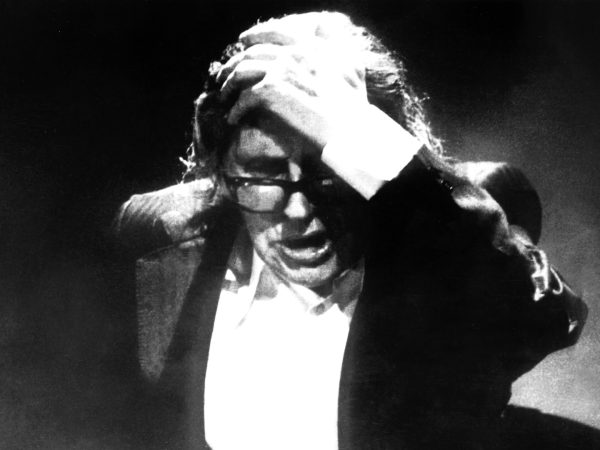
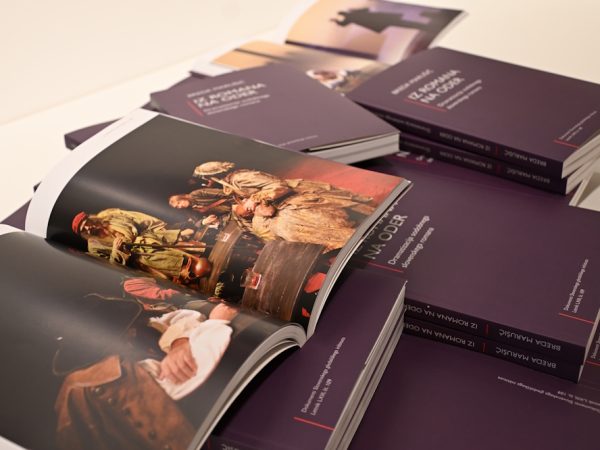
Museum Institute, who made a decisive contribution to the introduction of visual arts and contemporary dance into Slovenian performing arts in the 1990s, celebrates its 30th anniversaryIn addition, the Slovenian Theatre Institute and the Muzeum Institute co-published the book by director, producer and curator Barbara Novakovič. publication with a title Theatre as a Museum. Accompanying transparent exhibition Arhiv furioso, ki zajema uprizoritveni historiat Gledališča Muzeum v letih 1994–2024, bo po postavitvi maja in junija 2025 v Dvorani Slovenskega gledališkega inštituta na ogled peturna postavitev in prenos 15. novembra 2025, med 14. in 19. uro in Protokolarno-prireditveni dvorani sv. Frančiška Asiškega v Kopru. V sklopu odprtja razstave bo izvedena predpremierna prizoritev sintezne predstave trilogije o alegorijah (2021-2025).
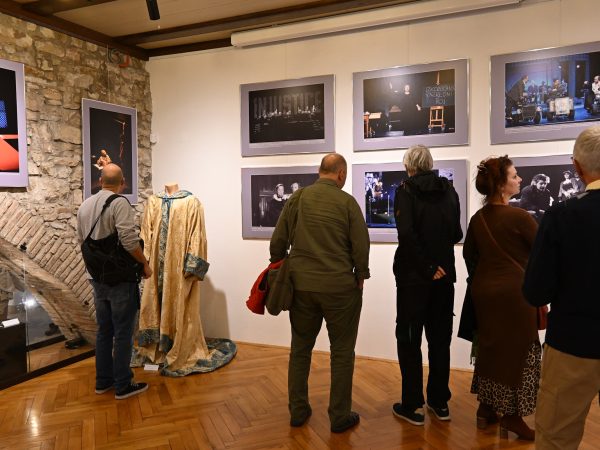
If sculpture is the image of the living, transferred into staticity and thus into potential eternity, then this exhibition can also be seen in the light of visual stage materials that enter the exhibition space as "architecture of props". They are fragments of an event that was once alive and surrounded by dynamics, but here they are read as exhibits that act as "eternal traces" and tangible imprints of theatrical productions that have, as a whole, irretrievably passed away. The visual images and visual artefacts are parallel dramaturgies within the duration of the event. On the one hand, they are an indispensable complementary part of the whole, on the other hand, they are completely independent elements of expression, symbol and effect.
A stage event in all its performative totality and temporal absoluteness can never be revived by reconstruction, it cannot happen again – every attempt is only an approximation, a utopian resurrection. The time that bordered its context is no more. And when the “same” contextual time (whether intimate or social) is no more, the essence of the original moment also changes. There is nothing bad or tragic about this, in fact we have been taught to love this very specificity. That no performance can ever return in the same autonomous turn and that our experience of observation is (was) radically conditioned by direct participation in the event. Liveliness, presence, community, proximity and simultaneity. Each of these concepts is most precisely valued and defined, so to speak semantically conditioned, only by social time, permeated with politics and philosophy – in their broadest sense.
What does it mean, then, to look at the performative past through the perspective of objects (which ignore neither politics nor philosophy)?
What does it mean to unfold your evolution of concepts through “inanimate” materials?
It means: to create a wonderful paradox.
What was once the most "inanimate" in a performance is now the most "real" here.
The objects, structures, and stage props, which are here exempt from the original event dramaturgy and space, cannot "replace" the essence and experience of the events, but despite everything, they carry within themselves and with them the extraordinary potential of their perfection, because - unlike the performers and the audience - they are exactly as they were then, in the past. They exist within themselves and above all for themselves. Only we attribute value, symbolism, and connotation to them. To mark or "mark" a former performance event with a focus on what is existentially understood as passive, lawless, and self-sufficient is in fact the most accurate. The silent omnipresence of objects-things, which once "played a role" in the performance event, today speaks with an exhibition voice that represents everything that is no longer there. What was around them has dissipated. Today, they ground a new event. Unlike co-located video documentation, visual matter is silent witness to the past and transience.
Exhibits on display at the exhibition, which are part of the opus Barbara Novakovic fundamentally marked the phenomenology of the selected performances, they are taken out of the original context and carefully relocated to a new one in order to tailor a new encounter, new relationships, verify existing memories of the past(s) and draw out the "material image / image of materials", which in the sphere of performance practice represent much more than we are aware of. At first glance, the exhibition objects/objects in our perception remain "exactly as they were" at the time; only reflection with a delay reveals the fundamental insight that their "materiality", which exists and resides beyond the sensory, verbal and rational, is constantly changing. Not because the changes are inscribed in them, but because they are inscribed in us.
Zala Dobovšek, PhD, dramaturge, theatrologue
Barbara Novakovic and the Museum
»Artistic signature of Barbara Novakovic, director, performer, producer and curator, has always been recognized in the Slovenian art scene as subversive, rich in references, humanistically focused and at the same time based on analytical knowledge of Slovenian and world art history. She has always stepped onto the scene in her own rhythm and with themes that, despite their historical relevance for contemporary times, often represented a risk and, so to speak, the "edge of the invisible", which, due to the complexity of the material, could not always be reflected on immediately, but only showed its influence over time. Her constant and close connection with the institute Museum, which she founded in 1996, she established a permanent but constantly evolving idea of infiltrating art history throughout her theatrical work and vice versa. On the Slovenian performance scene, she was also synonymous with "philosophical theater", which, as a concept creator and author of performances, she understands in an extremely complex and interdisciplinary way. Philosophical implications, which are evident in both approaches to content and performance formats, enter her expressions in a layered manner, on the one hand textually (literally), on the other as a substance, a kind of ineffable atmosphere. Philosophy as a raw reality, as a hard word, but at the same time also as a constantly present but invisible ring around our existences - on stage and in the audience.
The astonishingly extensive oeuvre of Barbara Novakovič and the Muzeum Institute reveals its political nature not only at the level of content or format, but is also reflected in the duality of the persistence of "women in the non-governmental sector", where hierarchies are duplicated, and vulnerability and (occasional) uncertainties can extend not only to the space of creation, but also to existence. It is also necessary to highlight the interdisciplinarity of her work, which has constantly moved between the visual (art history, material theatre), the performing (theatre, movement) and the philosophical (theoretical). The latter is read from an external perspective as a territory of specific inter-genre research, but we must not forget that the transition between different areas or artistic fields is still quite demanding; due to the combination of different aesthetic fields, it is necessary to constantly question the mechanisms, logic and even the obviousness of the other field and optimally place them in one's own language and expressive goal. "To put it very simply: we are not aware of the privilege of a common frame of reference until we step out of it and into another. Perhaps only then does the research truly begin. In fact, this is where the fundamental seeds of the experiment lie."
Zala Dobovšek, PhD, dramaturge, theatrologue
Arhiv furioso
pregledna razstava ob 30. letnici zavoda Muzeum (prenos)
Protokolarno-prireditvena dvorana sv. Frančiška Asiškega, Koper
15. november 2025, 14.00–19.00
Avtorica, kuratorka in umetnica: Barbara Novakovič
V sodelovanju z umetniki: Meta Kojc, Mare Mutić, Andrej Lamut in Vlatka Ljubanović
Besedila: Zala Dobovšek, Barbara Novakovič
Mizarska dela: Marko Udvanc, Miha Zupan
Artefakti in besedila: zavod Muzeum in arhiv gledališča Muzeum
Prostorska postavitev arhitekturnih elementov scenografije: Dana Čuk, Valentin Dowhyj, Juna Drobnič, Maša Ferjančič (študenti Fakultete za arhitekturo Univerze v Ljubljani, mentorica: doc. Vlatka Ljubanović, u.d.i.a.)
Video posnetki predstav: Mare Mutić, Gregor Gobec, Manja in Avguštin Solce, Y0Y Production
Fotodokumentacija: Manja in Avguštin Solce, Y0Y Production
Production: Muzeum, zavod za umetniško produkcijo posredovanje in založništvo
Koprodukcija: Slovenski gledališki inštitut (SLOGI), prvotna postavitev razstave 15. maj – 6. junij 2025 (SLOGI)
Podpora: Mestna občina Ljubljana, Oddelek za kulturo, Zavod za mladino, kulturo in turizem Koper, Ministrstvo za kulturo Republike Slovenije

With the support of the City of Ljubljana, the Department of Culture and the Ministry of Culture of the Republic of Slovenia.