The International Amfiteater Symposium
SPEECH ON THE (DARK) TIMES: BRECHT’S THOUGHT THEN AND NOW
6–9 October 2026
Ljubljana, Slovenian Theatre Institute
In a brief yet extraordinarily lucid fragment from Buying Brass, entitled “Speech on Our Times” (Rede über die Zeit), Bertolt Brecht offers a precise analysis of the social conditions shaping his historical moment, not merely in Germany but globally. In the fragment, a character bearing the generic name Philosopher observes that “the monstrous oppression and exploitation of human beings by other human beings, the wartime slaughters and peacetime degradations of every sort taking place across the planet have almost come to seem natural to us”. Despite the historical distance, this observation still resonates as an uncannily accurate commentary on the conditions of our contemporary moment, marked by capitalist exploitation, violence against human and non-human life, war and the climate crisis. We live in a time in which numerous regressive, increasingly popular and even institutionalised forms of authoritarian (micro-)politics are gaining ground, recalling the dark forces of past eras. These politics are rooted in racism, chauvinism, nationalism, xenophobia, transphobia, homophobia, sexism, class discrimination, ruthless exploitation, (neo-)colonialism, religious fundamentalism, environmental degradation, militarism and more.
“If our present-day world no longer fits drama,” Brecht told his collaborator Elisabeth Hauptmann one hundred years ago, “then drama no longer fits the world.” Thus, from its very beginning, Brecht’s project of the epic (dialectical) theatre appears to have been conceived as an attempt to enable theatre to respond to – and even intervene in – its historical moment. The symposium will provide an opportunity to reflect on what an effective theatrical and/or Brechtian response to our time might look like today – a time marked by neoliberalism and the rise of authoritarian politics. At the symposium, we will thus explore the relationships between art (theatre, playwriting, literature, etc.) and the contemporary social and political context and seek potential theatrical and other tactics capable of following Brecht’s maxim in The Measures Taken (and Buying Brass): “Change the world, it needs it!” The symposium aims to reflect, through Brecht and the questions raised by “Speech on Our Times”, on the “dark times” of his era as well as our own.
Forty symposium participants will present their views on the subject; we also invite you to join the discussions following the lectures and presentations. The working language of the symposium is English.
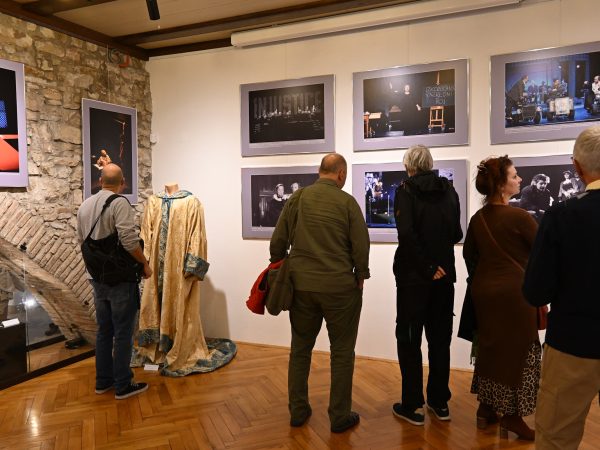
The symposium will begin on Tuesday, 6 October 2026, at 6 p.m., with the opening of the exhibition Theatre Work: Brecht on Slovenian Stages at the Slovenian Theatre Institute; the exhibition is dedicated to productions of Brecht’s plays in Slovenian theatre.
Tuesday, 6 October
18:00 Opening of the Exhibition Theatre Work: Brecht on Slovenian Stages (Slovenian Theatre Institute, Mestni trg 17, Ljubljana)
Production: Slovenian Theatre Institute (SLOGI) in collaboration with the Academy of Theatre, Radio, Film and Television of the University of Ljubljana (UL AGRFT)
Authors: Aldo Milohnić, Jakob Ribič (both UL AGRFT), Ana Perne (SLOGI)
Opening Speeches: Vesna Jurca Tadel (Acting Director-General of the Creativity Directorate, Ministry of Culture of the Republic of Slovenia), Gašper Troha (Director of SLOGI), Žanina Mirčevska (Dean of UL AGRFT), Lena Prents (Director of Goethe-Institut Ljubljana), authors of the exhibition
Short Opening Performances: Sofija Zavratnik Kain sings two songs by Bertolt Brecht and Kurt Weill; Anthony Squiers reads excerpts from his new translation of the poem Die drei Soldaten (The Three Soldiers) by Bertolt Brecht
Followed by a welcome reception
Wednesday, 7 October
8:30–9:00 Registration
9:00–9:40 First Keynote Lecture
Markus Wessendorf (University of Hawaiʻi at Mānoa, USA): A Contemporary Reassessment of “Five Difficulties in Writing the Truth”
9:40–10:00 Discussion
10:00–10:10 Short Break
10.10–10.55 First Panel
Contemporary Conversations about Refugee Conversations (and beyond)
Moderator: Jakob Ribič
Aleksandra Jovićević (University of Rome “La Sapienza”, Italy): Exiles and Émigrés, Then and Now
Lara Tarbuk (Dresden University of Technology, Germany): From the Margins of Language: Exile and Conversation in Bertolt Brecht and Senthuran Varatharajah
Miša Glišič (University of Ljubljana, Slovenia): The Refugee as the Architect of the Third Space: Rethinking Brecht’s Dialectics through Bhabha and Welsch
10:55–11:20 Discussion
11:20–11:40 Coffee Break
11.40–12.25 Second Panel
War and Pacifism in “Dark Times”: Then and Now
Moderator: Aldo Milohnić
Kristopher Imbrigotta (University of Puget Sound, Tacoma, USA): Taking Positions in Dark Times: Resistance, Authoritarianism and the Politics of Seeing in Brecht’s War Primer
Milena Mileva Blažić (University of Ljubljana, Slovenia) and Hans Zollner (Institute of Anthropology, Pontifical Gregorian University, Rome, Italy): Antimärchen: Brecht’s Children’s Crusade 1939 and the Hameln Legend
Milena Massalongo (University of Mantua, Italy):“What you don’t understand is the technique”: Where We Stand Now, Measured against Brecht
12:25–12:50 Discussion
12:50–14:20 Lunch Break
14.20–15.05 Third Panel
Puntila, Matti and Saint Joan in the Jungle of Capitalism
Moderator: Tomaž Toporišič
Jure Gantar (Dalhousie University, Halifax, Canada): Brecht and the Master-Servant Dialectic
Eva Kraševec (Slovenian National Theatre, Ljubljana, Slovenia): Puntila and Matti in Turbocapitalism
Agata Tomšič (ErosAntEros, Ravenna, Italy): Why Stage Brecht in the Age of Capitalist Realism? Two Practical Examples that Seek to “Change the World” through Theatre and the Power of Imagination
15:05–15:30 Discussion
15:30–15:50 Coffee Break
15:50–16:35 Fourth Panel
(Post)Brechtian Dramaturgies in Politically Committed Contemporary Theatre
Moderator: Maja Murnik
Tomaž Toporišič (University of Ljubljana, Slovenia): In the Footsteps of Brecht’s Fundamental Reforms of Dramaturgy in Contemporary Performing Arts
Matko Botić (University of Split, Croatia): Doubt as Destiny: Oliver Frljić’s The Brothers Karamazov as an Echo of Brechtian Epic Theatre
Milorad Mićić (University of Ljubljana, Slovenia): From Estrangement to Confrontation: The Post-Brechtian Theatre of Oliver Frljić
16:35–17:00 Discussion
18:00 Opening of the Exhibition Brecht’s Attempts and Experiments (Versuche) – Slovenian Translations, First German Editions and Documents from the Bertolt Brecht Archive of the Academy of Arts, Berlin (National and University Library, Turjaška ulica 1, Ljubljana)
Production: National and University Library (NUK) in collaboration with the Academy of Theatre, Radio, Film and Television of the University of Ljubljana (UL AGRFT)
Authors: Aldo Milohnić, Jakob Ribič (both UL AGRFT), Barbara Jesenovec (NUK)
Archival Material Consultants: Iliane Thiemann, Noah Willumsen (both Bertolt Brecht Archive of the Academy of Arts, Berlin – BBA/AdK)
Opening Speeches: Jana Kolar (Director of NUK), Iliane Thiemann and Noah Willumsen (BBA/AdK), Sylvia Groneick (German Ambassador to Slovenia), authors of the exhibition
Short Opening Performances: Sofija Zavratnik Kain sings two songs by Bertolt Brecht and Kurt Weill; Nataša Barbara Gračner “re-enacts” excerpts from Brecht’s Galileo, staged 30 years ago in NUK
Thursday, 8 October
9:00–9:40 Second Keynote Lecture
Tom Kuhn (University of Oxford, UK): “Brothers, if I were with you now…”: Brecht, War and Empathy
9:40–10:00 Discussion
10:00–10:10 Short Break
10:10–10:55 Fifth Panel
Learning and the Learning-Play in the Dystopian Times
Moderator: Aleksandra Jovićević
Aldo Milohnić (University of Ljubljana, Slovenia): Brecht’s “Theatre for the Scientific Age” in the Dystopian Times
Sergio Lo Gatto (Link Campus University, Rome, Italy): The Legacy of the Lehrstück in Contemporary Italian Playwriting: The Case of Davide Carnevali’s Classroom Plays
Francesco Puccio (eCampus University, Rome, Italy): Reassessing the Ruins: Sophocles’ Antigone as a Brechtian Lehrstück in Archaeological Spaces
10:55–11:20 Discussion
11:20–11:40 Coffee Break
11:40–12:25 Sixth Panel
Learning-Play as a Metaphor: Politics, Censorship and Brechtian Strategies
Moderator: Lada Čale Feldman
Elena Knopová (Slovak Academy of Sciences, Bratislava, Slovakia): Unsettling the Familiar Again: Brechtian Strategies in Contemporary Slovak Theatre
Sebastijan Horvat (University of Ljubljana, Slovenia): Jože Možina’s Interview with Tone Kerin on RTV Slovenia as an Example of a Learning-Play
Rita Agatina Di Leo (University of Bari “Aldo Moro” and University of Rome “La Sapienza”, Italy): Archipelago of Exceptions: When Visibility Becomes Censorable – Notes from Contemporary Italy
12:25–12:50 Discussion
12:50–14:20 Lunch Break
14:20–15:05 Seventh Panel
New Readings of the “Classic” Brecht-Aristotle Antagonism
Moderator: Goran Sergej Pristaš
Anthony Squiers (AMDA College and Conservatory of the Performing Arts, Los Angeles, USA): Beyond Aesthetics: Brecht’s Ontological Break with Aristotle
Krištof Jacek Kozak (University of Primorska, Koper, Slovenia): On How a Certain Bertolt B. Let Himself Be Ensnared by His Own Shadow
Vid Milaković (University of Ljubljana, Slovenia): Aristotle and Brecht in Contemporary Theatre – Clash of the Titans
15:05–15:30 Discussion
15:30–15:50 Coffee Break
15:50–17:00 Roundtable Discussion on Editions and Translations of Brecht’s Writings
Brecht’s Legacy 70 Years On
Moderator: Jakob Ribič (University of Ljubljana, Slovenia; editor of the recent Slovenian translations of Brecht’s writings)
Speakers:
Aldo Milohnić (University of Ljubljana, Slovenia; editor of the recent Slovenian translations of Brecht’s writings)
Darko Suvin (Emeritus Professor, McGill University, Montréal, Canada)
Noah Willumsen (Director of Bertolt-Brecht-Archiv, Akademie der Künste, Berlin, Germany)
Erdmut Wizisla (Director of Walter Benjamin Archiv, Akademie der Künste, Berlin, Germany)
18:00 Guided Tour of the Exhibition Cosmos Kosovel – an exhibition marking the 100th anniversary of the death of the Slovenian avant-garde poet, writer and artist Srečko Kosovel (Cankarjev dom, Prešernova cesta 10, Ljubljana)
Guides: Marijan Rupert (NUK, exhibition curator) and Kristina Pranjić (ZRC SAZU and University of Nova Gorica, member of the exhibition Programme Committee)
Friday, 9 October
9:00–9:40 Third Keynote Lecture
Bojana Kunst (Justus-Liebig-Universität Giessen, Germany): When We Can No Longer Even Speak of Trees: Brecht and the Risk of Speaking the Truth
9:40–10:00 Discussion
10:00–10:10 Short Break
10:10–10:55 Eighth Panel
Estrangement and the Politics of Gaze, Perception and Spectatorship
Moderator: Gašper Troha
Goran Sergej Pristaš (University of Zagreb, Croatia): Composite Gaze and Vulnerable Assemblies
Jakob Ribič (University of Ljubljana, Slovenia): “The Eyes of the Stranger”: What Might Be the Contemporary Form of Verfremdung?
Yujia Zheng (University of Ljubljana, Slovenia): Estranging the Hyper-Spectator: Brecht after Rancière
10:55–11:20 Discussion
11:20–11:40 Coffee Break
11:40–12:25 Ninth Panel
Oppositions in Institutional and Alternative Approaches to (Post)Brechtian Theatre
Moderator: Noah Willumsen
Agata Juniku (University of Zagreb, Croatia): From Margins to Freedom, Centre to Avoid: Two Cases
Ana Kocjančič (University of Ljubljana, Slovenia): Brechtian Spatial Principles and Scenographic Minimalism in the Early Work of Niko Matul
Ana Perne (Slovenian Theatre Institute, Ljubljana, Slovenia): Brecht’s Theory as a Factor in the Transformation of Acting Practices in Slovenia
12:25–12:50 Discussion
12:50–14:20 Lunch Break
14:20–15:05 Tenth Panel
Brecht and (Un)expected Relations through Writings, Music and Voice
Moderator: Jure Gantar
Lada Čale Feldman (University of Zagreb, Croatia): Krleža through Brechtian Estrangement: On the Shared Artistic, Cognitive and Political Value of Two Modernist Classics
Gregor Pompe (University of Ljubljana, Slovenia): Brecht’s Idea of Epic Theatre in the Operatic Context of His Time
Jasmina Godec (University of Ljubljana, Slovenia): Estrangement on Radio: Brecht, Listening and the Representation of Madness
15:05–15:30 Discussion
15:30–15:40 Short Break
15:40–16:00 Closing Chord: a Music/Performative Presentation
Jani Kovačič (Singer and musician, Ljubljana, Slovenia): Did Brecht Teach Us Anything? On Some of Brecht’s “Stücke und Lieder”
18:30 Bus Transfer to Novo Mesto
20:00 Performance: The Life and Times of Bertolt Brecht (Anton Podbevšek Teater, Prešernov trg 3, Novo Mesto)
22:00 Farewell Reception
23:00 Bus Transfer to Ljubljana
Heads of the symposium: Aldo Milohnić and Jakob Ribič
Organising committee: Aldo Milohnić, Maja Murnik, Jakob Ribič, Tomaž Toporišič, Gašper Troha, Markus Wessendorf and Noah Willumsen
The symposium is organised by:
The Slovenian Theatre Institute
The Academy of Theatre, Radio, Film and Television of the University of Ljubljana
Amfiteater, Journal of Performing Arts Theory
In collaboration with:
Bertolt-Brecht-Archiv (Akademie der Künste, Berlin)
International Brecht Society
Goethe-Institut Ljubljana
National and University Library
Založba /*cf. Press
Anton Podbevšek Teater
Cankarjev dom



The symposium is organised within the framework of the research programme UL AGRFT Theatre and Interart Studies (P6-0376), co-financed by the Slovenian Research and Innovation Agency (ARIS) from the state budget.