Slovenian Theatre News, ki ga razpošiljamo partnerjem v tujini, prinaša najboljše, kar ponuja sodobno slovensko gledališče. Slovenski gledališki inštitut na spletnem portalu Oder objavlja kritike večine gledaliških uprizoritev v Sloveniji. Dvakrat na leto v angleščino prevedemo kritike desetih najboljših predstav po izboru avtorjev in Zale Dobovšek, odgovorne urednice Kritike.
Druga polovica sezone 2025/26 je znova ponudila vrsto premier, ki sta jih zaznamovali estetska razgibanost in vsebinska angažiranost. Tokratni nabor izbranih kritik vključuje širok spekter predstav in njihovih raznolikih kontekstov, produkcijskih zaledij in umetniške izraznosti. Izbor med drugim izkazuje sliko aktualnega stanja slovenskega gledališča, ki ga med drugim zaznamuje vrsta poskusov uprizarjanja in reprezentacije, ki vztrajno preizprašujejo obstoječe dominantne mehanizme v družbi. Zaznati je močno težnjo po radikalnih reinterpretacijah mitov in »uradne« zgodovine, ki je zadnje čase vse bolj motrena s točke spregledanih perspektiv, se pravi, kritično obravnavana v luči feminističnih in razrednih kontekstov, ki so nemalokrat obrobljeni in obogateni tudi z dokumentarističnimi prvinami. Prav estetika dokumentarizma je morda eden najbolj stalnih in razvijajočih se scenskih pristopov v tem obdobju pri nas. V tokratni izbor so umeščene kritike dramskih, performativnih, sodobnoplesnih in lutkovnih uprizoritev, s čimer se kaže tako raznovrstnost aktualnih metod uprizarjanja kakor tudi avtorskih pisav kritičark in kritikov.
dr. Zala Dobovšek, dramaturginja ter glavna in odgovorna urednica Kritike
Preberite >> Slovenian Theatre News, July 2026 Edition
Jaka Smerkolj Simoneti
Completing the Director’s Journey
Devised project: 1983. Dodecalogy 1972–1983. Slovene National Theatre Nova Gorica, European Capital of Culture GO! 2025 Nova Gorica–Gorizia and the Krušče Creative Centre. The event is part of the official GO! 2025 programme.
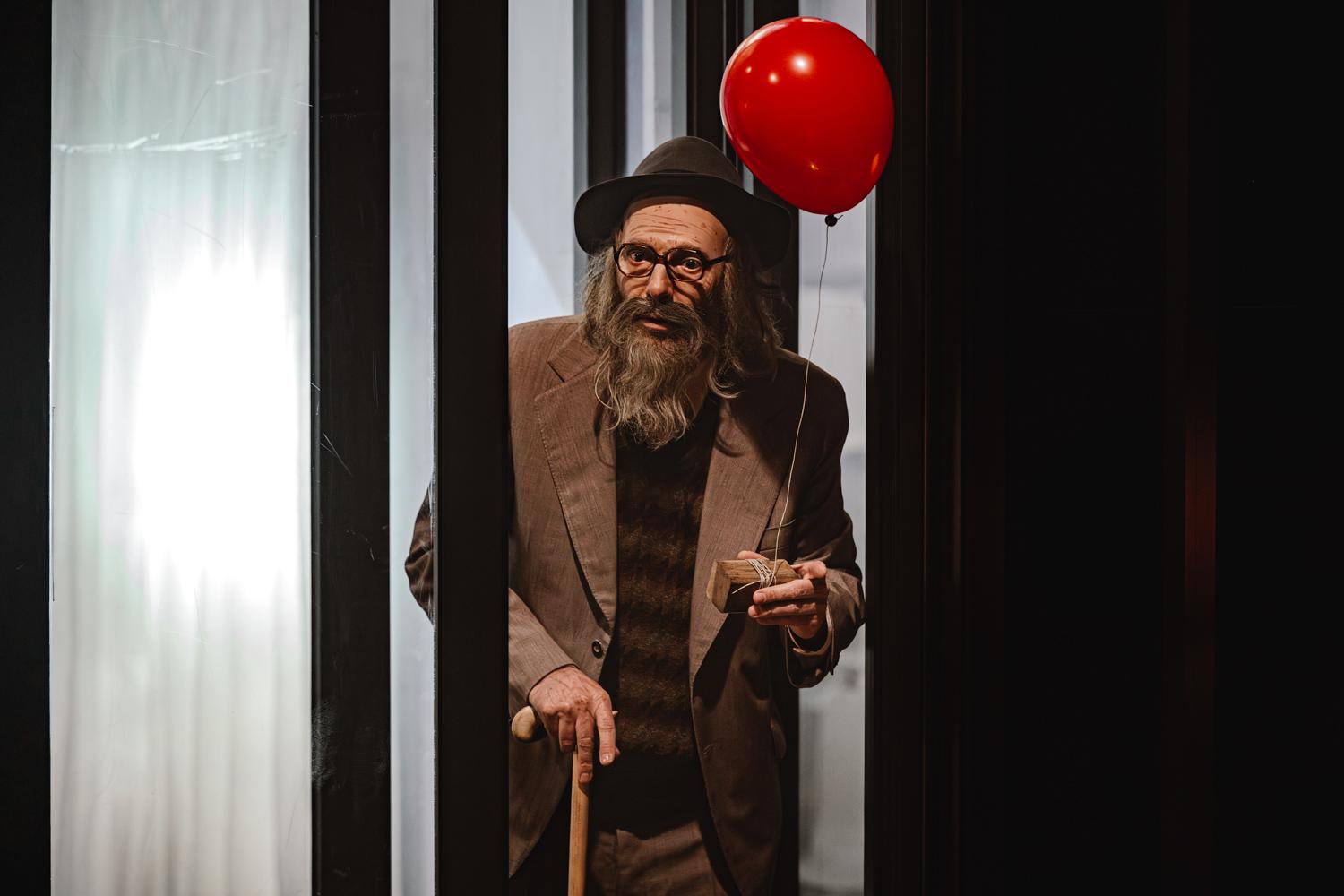
Last weekend’s production 1983 marked the end of Dodecalogy 1972–1983 – both the core of the theatre programme of the European Capital of Culture GO! 2025 and one of the most ambitious and demanding projects of the Slovenian performing arts landscape in recent times. 1983 is conscious of the imposing scale of the cycle it brings to a close and of the impossibility of fulfilling all the expectations that we, the audience, have built up while attending its monthly instalments. Rather than becoming one final production in a formally quite similar series, it opts for a distinctive ritual of farewell, or of “returning” home to our own time. The gradual abandonment of the world of Dodecalogy, which places the director Tomi Janežič in the role of the protagonist, is thus primarily intertwined with the production of a kind of nostalgia aimed at audience members who saw all twelve productions and joined the creators on this journey. More significant to the project than the broader sociopolitical events of the title year – which provided the backdrop to the family stories in the individual productions – is 1983’s status as a turning point: it was then that Janežič’s family moved out of their flat on Cankarjeva ulica in Nova Gorica. The Dodecalogy is thus the director’s theatrical return to the time of his childhood, while 1983 is the most explicit and personal production in this chapter. By foregrounding childhood memories and impressions and tracing the recurrence of these motifs throughout the director’s artistic oeuvre – curtains, pianos, carpets, cigarettes, snowfall and so forth – 1983 lays bare, to some extent, the very process through which Dodecalogy 1972–1983 was conceived. Social reality intrudes upon a child’s perspective only when it directly affects the protagonist and those closest to him; this perspective is more interested in momentous events in one’s own life than in momentous events in the wider world. This characteristic – which can be discerned in 1983 as well as in most of the other productions in the warm, emotional atmospheres of the interpersonal stories, at times creating the impression that they are unfolding in some kind of a floating state, a utopia detached from time and space and, above all, revealing a rather narrow excerpt of life – remains emblematic of this monumental theatre project. The cast of 1983 – featuring actors Anuša Kodelja, Arna Hadžialjević, Marjuta Slamič and Stane Tomazin and prompter Maja Dvoršek – enacts it in a true pre-Christmas atmosphere. However, they appear not so much as their eponymous stage selves – though these still occasionally pop up for a moment or two – but as a kind of collective narrator, telling the story of the director’s childhood memories. The cast is joined by assistant director Mojca Madon, whose function is more clearly defined and who is costumed as the director himself, and by director Tomi Janežič, who appears as a charmingly confused older man – a paraphrase of the Wizard of Oz. The Wizard’s story becomes the central metaphor for the impossibility of bringing such an extensive journey to a satisfactory conclusion and of returning home after whatever ending it may reach. Although Madon confidently plays the role of director, prompting movements and lines and otherwise intervening in the course of the performance in a recognisably Janežičian manner, Janežič himself, when he appears onstage, never entirely sheds his actual role as director nor fully surrenders to the role of the lost old man. Their performances, like the possible symbolic undertones of passing the director’s torch to the next generation, are therefore suggested rather than fully realised. The production concludes in a similarly nostalgic atmosphere with an exceptionally heartfelt and personal video by Carlo Zoratti, in which we learn that shortly before the Dodecalogy came to an end, Zoratti lost his father, one of the protagonists of his video clips throughout the cycle, and that he now brings the theatrical epic to a close while awaiting the birth of his own child. The video is accompanied by short inserts from the creative processes behind the individual productions, including excerpts from rehearsals and meetings, which complement the meta-theatrical narrative of the live portion of 1983. The twelfth part of Dodecalogy thus brings the entire cycle to a remarkably honest conclusion, without grand spectacles or surprises, while preserving the heart and sincerity that formed the central thematic thread running through its countless stories. Across these narratives, perhaps what we missed was greater formal diversity, more layered content and sharper dramatic developments. However, Dodecalogy 1972–1983 undoubtedly created a safe bubble in the cruelty of the present, establishing a space for a radically optimistic narrative that, considering the aforementioned cruelty, seems very much needed to the spectator. On a content level, the only question that raises our scepticism is who is allowed to create such spaces, and who is excluded from them. Month after month, the scale of these events also demonstrated what a theatre is capable of producing when it has sufficient financial resources, while revealing the interdependence between the power of theatre and the contexts in which it is created. Dodecalogy 1972–1983 is an expression of artists who are allowed to dream and to make at least part of these dreams come true. In the performance 1983, when listening to the descriptions of scenes from some other performances that took place in other countries and watching the fragments of their reconstructions, we begin to wonder about the future of Slovenian theatre and the opportunities, such as the European Capital of Culture, for creating such works of art in it. The powerful legacy of Branko Hojnik’s complex set designs, Marina Sremac’s detailed costume designs, Samo Kutin and his team’s emotional soundscapes, the finely honed direction of Tomi Janežič and his assistant directors and the many memorable performances by the actors will certainly find a place in the history of Slovenian theatre.
CONTACT @PRODUCER (SNT Nova Gorica): info@sng-ng.si
Tjaša Bertoncelj
The Moment Before Catastrophe
Dijana Matković, Lučka Neža Peterlin, Jan Krmelj and the cast: Lackeys, a documentary for the future based on motifs from Ivan Cankar’s Lackeys. Celje City Theatre, 9 January 2026.
»One of the key concerns of Cankar’s Lackeys is the question of passivity and servitude as well as action and resistance, which the contemporary stage interpretation translates directly into a reflection on our relationship to freedom, current injustices and our own responses to them.«
Director Jan Krmelj uses Ivan Cankar’s play Lackeys as the basis for an in-depth reflection on the present and future. The very title Lackeys, a documentary for the future reveals the prism through which he approaches this Slovenian literary classic: the idea of the near future. This is a highly innovative principle, since theatre generally dwells in the past or present, regardless of whether its narrative is realistic or fictional. The perspective of the future arises from the renewed – or rather, enduring – relevance of Cankar’s Lackeys and is developed consistently in both the staging concept and the thematic emphases of the action.
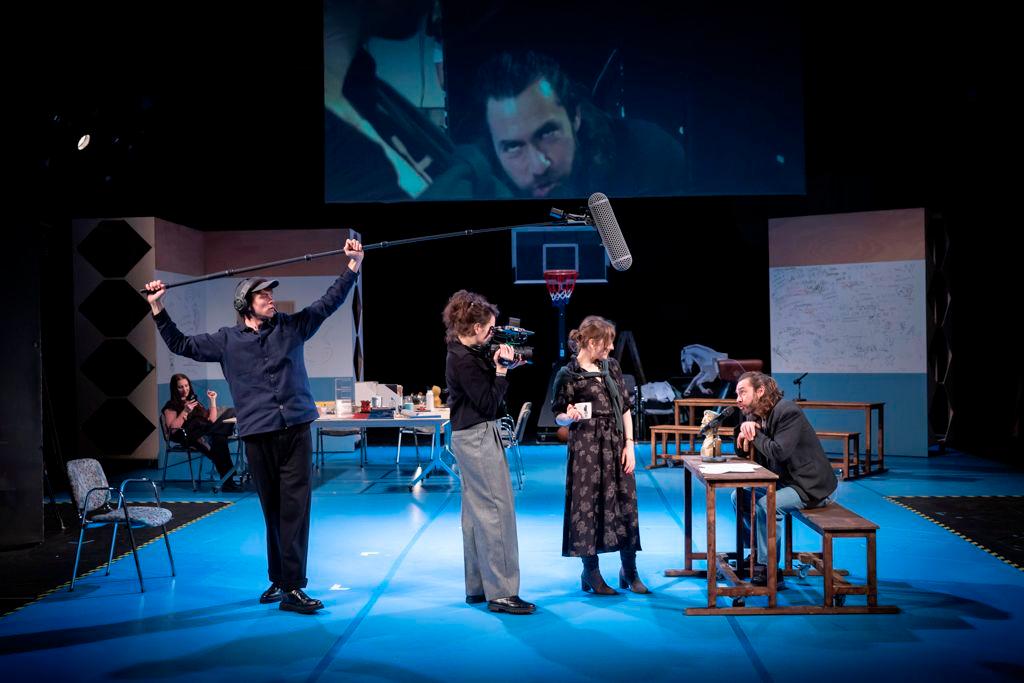
We follow the behind-the-scenes process of filming a documentary about Lackeys in the near future, at a time marked by problems similar to those surrounding the creation of the original. The central characters, Jerman and Lojzka, are making a film to mark the 150th anniversary of Cankar’s birth. The filming and simultaneous projection are among the production’s principal theatrical devices, allowing the spectator to perceive the action on two levels. This does not provide an additional, deeper perspective so much as reinforce the form of a documentary film shoot, while also emphasising the veil between theatrical imagery and the real world and showing just how close we are to actual reality. Although this mode of staging establishes a clearly legible structure, the relationship between stage and projection could at times be used more emphatically to deepen or shift the perspective.
The action centres on a secondary school before and after the elections of February 2026, when a new fascist decree and censorship transform everyday life. The protagonists document the staging of scenes from Cankar’s original play, their relationship to the literary work and a contemporary parallel that foregrounds relationships and responses to current social reality. This parallel embodies the idea that the structure of society, conformism and responses to injustice and authority have not changed significantly. As the production unfolds, the contemporary counterparts of Cankar’s characters increasingly assume and enact roles from the original text. With the introduction of the decree, the costumes (Brina Vidic) also gradually shift from contemporary to more archaic dress, visually emphasising the cyclical nature of history and the repetition of social patterns. Past, present and future are thus established as part of the same circular process: a cycle of history in which violence repeatedly escalates. The dramaturgical arc likewise follows the escalation of social tension, developing from seemingly innocuous human frustrations and cynical remarks into overt physical violence against individuals.
The production clearly articulates its convictions and ideas, both through its theatrical form and through their direct expression in words and actions. At several points, it explicitly emphasises the concept of non-linear history and invokes Walter Benjamin’s anti-linear understanding of history, according to which every historical moment is caught in a state of danger and every document of culture is at the same time a document of barbarism (Benjamin, On the Concept of History, 1940). This idea is not merely stated or expressed through the production’s organising principle; it is also embodied in concentrated form in one scene, where the continuity of violence is revealed through the filming of miniature artefacts from the past and present: from miniature soldiers and battle scenes to a gas mask, the burning of witches, the French Revolution and a satirical poster depicting hanged Slovenian artists. Different historical moments merge into a single flow, clearly demonstrating that it is not the structure of violence that changes, but only its manifestations.
The production addresses not only the violent, recurring substratum of history but also the human response to it. The significance of reflecting on the future lies precisely in questioning what we understand as reality in the first place and how we relate to the approaching horror. What is particularly interesting is this focus on the moment before catastrophe – the calm before the storm. The moment we are living through right now. And the warning of a possible future that could become our reality.
This relationship unfolds in Lackeys, a documentary for the future through a complex portrait of the individual characters. The production addresses not only their servile or rebellious responses to the new decree and social reality but also their positions on everyday social issues. The comprehensive characterisation (dramaturgy by Lučka Neža Peterlin) is expressed through both personal convictions and minute gestures. Dialogue crystallises highly realistic portraits of contemporary social positions and of the ways people argue for and validate their own beliefs. The characters are treated with complexity in their facial expressions, speech, movement, motivations and modes of action, visible even in the smallest reactions or comments during the filming of the documentary. These brief inserts make the action still more realistic, human and tangible. The characters emerge onstage as complex human beings, embedded in different contexts and ideologies and in the consequences of their own choices. This, in turn, shapes how they respond when the situation intensifies.
Within the context of critique, freedom and servitude, each character is positioned in the tension between courage, rebellion, “chaos”, freedom and critical thinking on the one hand and order, discipline, hierarchy, obedience and complete moral and spiritual subordination on the other. Each character is realised with great precision, both conceptually and in performance. The gallery of characters embodies the mechanisms of servitude and ideological subordination while clearly demonstrating possibilities for resistance, even at the cost of personal ruin. Adaptation to new, inhumane conditions is revealed through the responses of different characters, both in passive, pragmatic and conservative forms of servitude and in active servitude, which assumes control over the implementation of ruling ideologies. The creators make an important shift in their treatment of Lojzka (Mojka Končar). In this contemporary interpretation, she moves beyond the original’s sentimental and stereotypically feminine framework and is given clear agency, determination and inner strength. Her loyalty to her ideals is not passive but conscious and active, which is precisely why she ultimately loses the most because of it. Nevertheless, she demonstrates that an individual can adopt a critical stance even in an environment systematically crushed by structures of power.
Through these varied positions, which become even more clearly delineated after the Slovenian Conservative Party wins the election on a radical programme, the production also interrogates our own response to the forthcoming elections and the danger of the rise of the radical right. It does not remain enclosed within its own form but opens outward, commenting on the current political and cultural landscape both in Slovenia and internationally. Although contemporary theatre productions addressing social problems often seem to resort to an overload of themes and conflicts, the critical portrayal here follows clear lines and does not feel overburdened.
The production takes a clear position on a horrifying reality and a future that appears even more terrifying, while placing both in relation to the past, present and future. One of the key concerns of Cankar’s Lackeys is the question of passivity and servitude as well as action and resistance, which the contemporary stage interpretation translates directly into a reflection on our relationship to freedom, current injustices and our own responses to them. The emphasis is not on moralising but on unpacking the complexity of human responses and revealing some of the mechanisms that bind individuals into positions of servitude, from fear and coercion to the everyday defensive strategies of avoidance, adaptation and pragmatism.
Deep reflection on its layers, ideas and expressive procedures is evident in the production. It does not resort to excessive metaphorical symbolism but explores its themes directly and clearly, without settling for a simple narrative premise. The central concerns – non-linear history, violence and censorship, servitude and rebellion – run through all the production’s parallel layers. The production is equally accomplished at every level – direction, dramaturgy and performance – with exceptional work from Lovro Zafred (Ivan Jerman), Eva Stražar (Anastazija Komar), Lučka Počkaj (Judít Pomóčnik), Urban Kuntarič (Peter Betaj and the Parish Priest), Maša Grošelj (Anka M. Geni) and Andrej Murenc (Marko Hvastja). The set design (Lin Japelj) and musical landscape (Vid Greganović) also help create the hybrid space of past and present.
In true Cankarian fashion, the production becomes a powerful paean to critical thinking and knowledge. This is undoubtedly one way of standing up to the world, in art as in everyday life. As the saying goes, “Freedom cannot be taken for granted; it must be won again and again.” And although placing our hopes in the rebellious power of art (and science) may seem like a worn-out, constantly repeated motif, current circumstances show that it must be preserved, at the very least, as an essential foundation.
CONTACT @PRODUCER (Celje City Theatre): mojca.redjko@slg-ce.si
Jaka Bombač
One Tragic Heroine or Two?
Friedrich Schiller, Diego de Brea: Mary Stuart. Drama of the Slovene National Theatre Maribor, 21 March 2026.
»Mateja Pucko conveys with great emotional nuance the tension within Elizabeth – the second woman, after Mary Tudor, to occupy the English throne – between a monarch’s cold authority and adherence to principle under pressure from both the law and the people and a deeply human inner uncertainty bordering on profound existential doubt.«
With the staging of Mary Stuart by the German classicist playwright and idealist philosopher Friedrich Schiller, directed by Diego de Brea, the Drama ensemble of SNT Maribor continues its thematic approach centred on female characters from the dramatic canon, with particular emphasis on their tragic dimension. This thematic continuity was already apparent last year, especially in the final premiere of the previous season, Phaedra (directed by Livia Pandur), in which the role of the tragic female protagonist – like in Mary Stuart – was played by Nataša Matjašec Rošker. It is interesting to compare Mary Stuart with Phaedra, since Schiller’s intellectualist classicist tragic melos diverges significantly from that of antiquity and requires a moment of the tragic sublime, as well as its suspension through aesthetic distance, which prompts a questioning of the dramatic characters’ moral motivations.
Structurally and dramaturgically, the production is clear and precise; it is roughly divided into three parts (dramaturg Maja Borin). The five-act structure of the original play has been abandoned in its staging, as the acts are not explicitly marked, and the scenes are broken up into fragments or vignettes by sudden cuts. The tripartite division supports a dialectical or polemical reading (following the principle of thesis, antithesis, synthesis) rather than a tragic one. The individual parts function as elements of an argument – two premises and a conclusion – between two different worldviews, Catholic and Protestant, which in Schiller’s philosophical thought partly overlap with the Romantic and the Enlightenment worldviews respectively.
The opening scenes depict the guards bringing Mary Stuart (Nataša Matjašec Rošker) to the royal prison on suspicion of plotting to kill Queen Elizabeth I of England and seize her throne. Invoking her sovereignty, Mary Stuart questions the judges’ interpretation. She keeps repeating that the court is twisting the facts and that she is being tried for offences that she did not commit and on the basis of personal grudges. Both the acting and the montage of the dialogue make it clear that for Mary, Queen of Scots, there is something more at stake than mere survival: the inconsistency between the “official” truth of the English court and her experiential truth, which, symbolically speaking, is also the truth of her kingdom. What initially seems like a Romantic critique of the Enlightenment and its conception of the subject can, in another context, be understood as a form of monarchical nationalism, in which the queen serves as the guarantor of truth.
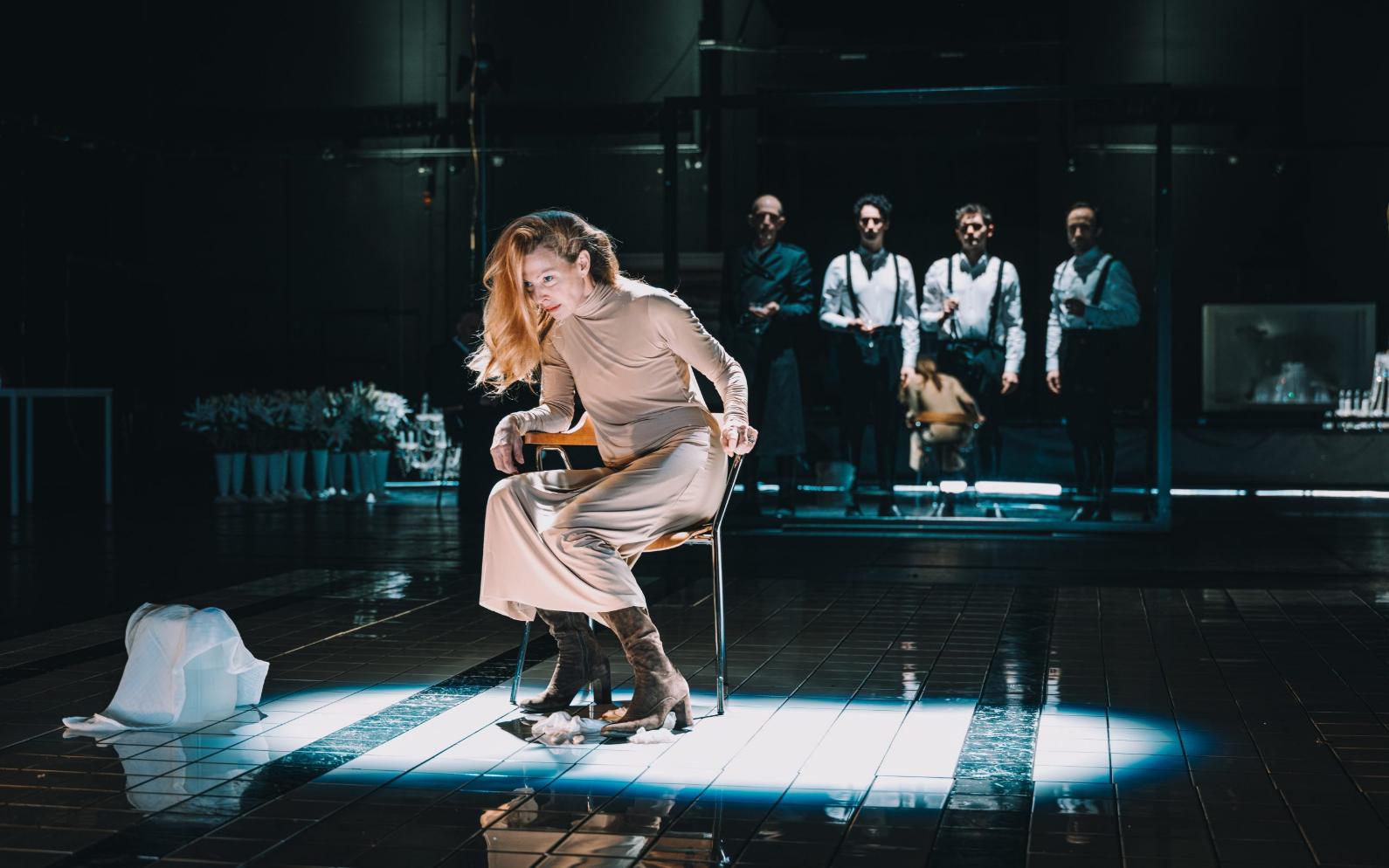
In the second part, the performance focuses on the character of Queen Elizabeth, superbly portrayed by Mateja Pucko. She conveys with great emotional nuance the tension within Elizabeth – the second woman, after Mary Tudor, to occupy the English throne – between a monarch’s cold authority and adherence to principle under pressure from both the law and the people and a deeply human inner uncertainty bordering on profound existential doubt. The structural homology of the first two parts is clearly signalled by two scenes in which a chorus comprising the same three subjects follows each queen in choreographed unison. The subjects are played by Matevž Biber, Nejc Ropret and Žan Koprivnik, with Koprivnik standing out in the role of Leicester. These mirrored scenes signal both the power relations and the blood and family ties between the English and Scottish kingdoms. The consistent emphasis on kinship in the dialogues between the subjects and the two queens first makes us question the English queen’s adherence to principle, then that of the other characters and ultimately the very possibility of adhering to principle at all.
The staging does not make it entirely clear whether both heroines are conceived as tragic, or whether Mary Stuart is nevertheless the more tragic one due to her resignation to her destiny (which will be addressed in this critique’s conclusion). Although Elizabeth declares herself torn between serving the people and serving the law, Mateja Pucko embodies a deeper tension within her, apparent in her behaviour and physical cues, thereby bringing out the polemical dimension of Schiller’s text. Her face can by no means conceal the restlessness that arises from her doubting herself and her decisions. Pucko’s performance, as well as the dialogue and costume design, increasingly reveals Elizabeth’s subjective motivations for punishing Mary Stuart. She wears a black sheepskin coat that she repeatedly opens in front of her subjects in a gesture both suggestive and shy to reveal a black corset underneath. The corset underscores her physicality and sexuality – her own desire and what she supposedly envies in Mary Stuart, an adulteress and a free woman.
Aesthetically, the production employs fairly classical theatrical and visual means, especially colour symbolism. Elizabeth initially wears a black sheepskin coat but appears in a magnificent white royal cloak in the final scene; by contrast, Mary Stuart is initially dressed in lighter shades and wears a plain black dress in the final scene (costume designer Jelena Proković). The production also draws on classical visual art, using three Renaissance paintings positioned on stage: Hans Holbein’s image of the dead Christ in the tomb on the left, an image of a lamb by an unidentified artist on the right, and a Renaissance depiction of the firmament high on the back wall.
In terms of direction, the staging walks a thin line between minimalism and maximalism. The narrative clarity allows the spectator to follow the subtle accents of the dramatic conflict without getting lost in the verse form. The actors’ earset microphones ensure that the verse does not sound artificial, that the actors do not merely recite it but rather take it in and embody it (sound design by Igor Potočnik). The microphones allow a wide range of vocal expressions to be heard – whispering, sobbing and muffled shouting – conveying subtle emotional nuances. This proves particularly successful in the final part of the performance, in which Elizabeth finally agrees to confront Mary Stuart. Mary Stuart pleads for clemency from the forestage, addressing the audience directly, while Elizabeth stands behind a sheet of plexiglass that separates the front and rear of the stage and shouts her lines at the top of her lungs into a microphone adjusted to limit the volume and frequency range of her voice. Elizabeth’s dampened screaming is terrifying, especially since, in the second part, we watch doubt gradually erode her inner integrity.
On the other hand, an abundance of stage signs, shifts between classical and modern musical accompaniment and the heterogeneity of stage props create a contrast with this minimalism (set and lighting design and music selection by Diego de Brea). Most of the props have no practical use but merely a symbolic function: white lilies symbolising rebirth, crystal chandeliers lying on the floor symbolising the royal strife or the fallen kingdom, and the aforementioned paintings, which symbolically convey various aspects of the dramatic conflict. In the first part, in particular, the scenes are fragmented and repeatedly interrupted prematurely – the actors suddenly freeze in place, then walk offstage quickly, while others replace them on stage.
The shift from classical piano or string music to more modern digital house music introduces discontinuities into the otherwise continuous development of the dramatic narrative. Such a (de)montage of scenes subtly establishes the difference between the first and the second part, between Mary Stuart’s fragmented Romanticism and the English queen’s more down-to-earth, Enlightenment stance (the scenes in the second part are longer and more coherent). The sudden cuts can also be jarring at times, especially in the opening scenes of the first part, when the dramatic conflict is not yet clearly defined, and one might wish for a more visually striking introduction rather than a series of short scenes sometimes lasting only a few seconds.
The dualism of the two queens, who are both tragic characters, albeit in different senses, is based on two different worldviews, two truths; on two individuals and their different languages; and on two nations and their different rights. When Mary Stuart snaps at one of her subjects that she finds the discrepancy between the truth and her experience outrageous, she is essentially insisting that we accept her interpretation of the truth. On the subject of interpretation, one might also ask who can readily access the interpretation of a production that contains numerous references to historical events and the symbolism of classical visual art. The problem posed by this intellectualist interpretation is partly mitigated by the emotionally nuanced acting and clear dramaturgy, which successfully contextualise the central dramatic conflict or problem. However, it seems that the depiction of the tragic sublime in the final scene leaves too little room for a deeper problematisation of Mary Stuart’s character, which would come more clearly to the fore if the moment of the tragic sublime were held in suspension.
CONTACT @PRODUCER (Slovene National Theatre Maribor): spela.lesnik@sng-mb.si
Ana Jerman Obreza
Down the Slope
Ivan Cankar: On the Slope. Cankarjev dom, première 28 January 2026, date of viewing 28 February 2026.
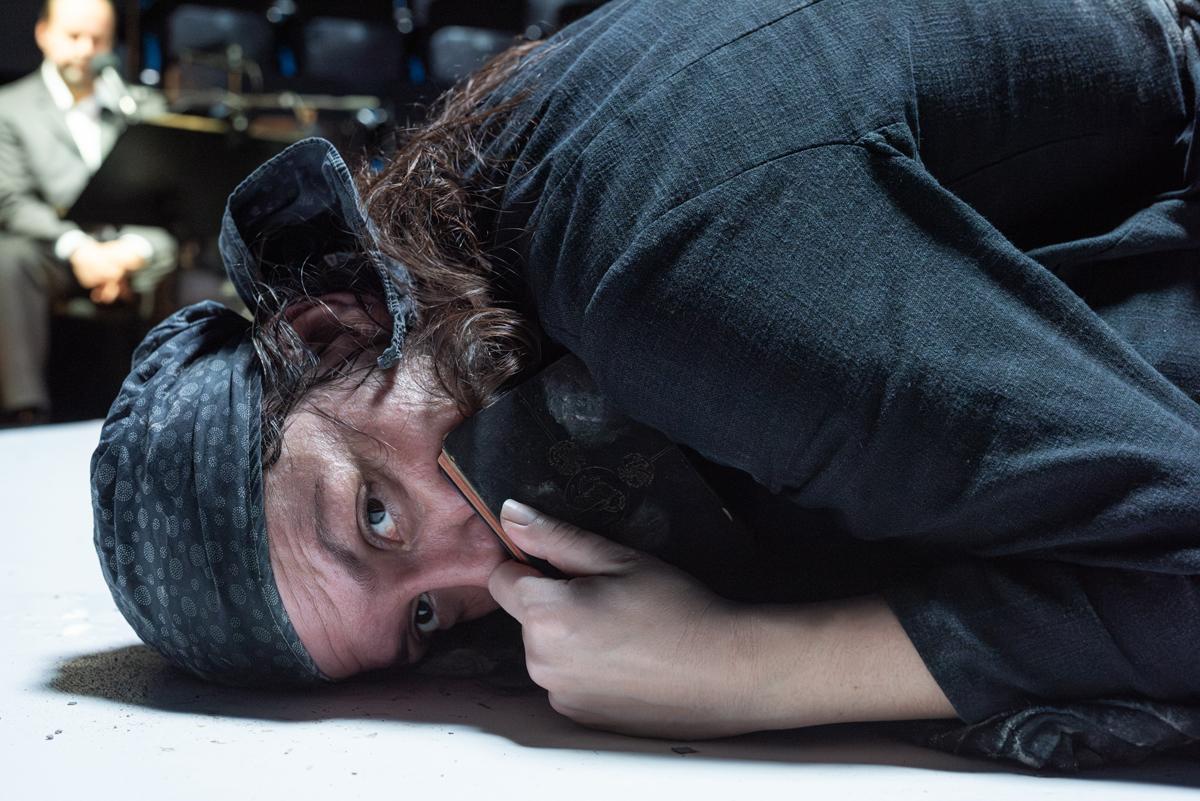
»The staging concept of Lorenci’s On the Slope is simple: two actors, a literary text, a spare set, simple costumes and a handful of props. «
“The Slope: Then, Now, Always?” is the theme of this year’s essay for the secondary-school graduation exam (matura) in Slovenian language, whose required reading comprises two novels with the same title, On the Slope, by Ivan Cankar and Tina Vrščaj: the first written in 1902, the second published 120 years later. Cankarjev dom – which is also commemorating the 150th anniversary of Cankar’s birth – decided to bring to the stage this literary masterpiece, which marked the writer’s first major success with the public. It is hardly surprising that director Jernej Lorenci was invited to the project, since minimalist adaptations of prose works have formed an important part of his theatrical practice over the past decade – The Visoko Chronicle (2018), The Man Who Lived in a Shell (2021), Francis (2022) and Struggle at the Sinkhole (2024), to name but a few.
The staging concept of Lorenci’s On the Slope is simple: two actors, a literary text, a spare set, simple costumes and a handful of props. On the circular floor of Štih Hall stands a white square, a stage on which a life will be played out; at its edge stand a lectern holding the text and a microphone from which that life will be dictated (set design by Branko Hojnik). At first, Gregor Zorc, as Tone, occupies the position of narrator/reader, while Tamara Avguštin, as Francka, lies in the middle of the white expanse, eyes open, dreaming of tomorrow. Zorc appears in a classic men’s suit (later given a little more character by braces and a hat), while Francka’s simple, washed-out black outfit is defined by an apron, a headscarf and old-fashioned shoes (costume design by Belinda Radulović). A white handkerchief, a prayer book, a piece of bread and a stone are not merely functional objects but symbolic harbingers of deeper meaning.
Through its effective use of reduction in the adaptation, costumes and set, the production dispenses with all decoration and illustration. This allows spectators to focus more closely on the text and enter into the mental states of the characters portrayed. The actors access these states through physical actions pushed to extremes. The first is Francka’s run after the cart: the actress runs on the spot to the beat of a metronome, turning to face all four directions, while her fellow actor winds the metronome up to an ever faster tempo and further intensifies the vortex of Francka’s distress by berating and humiliating her. When Francka strikes her forehead against the cart and falls, the actress remains on the floor, genuinely exhausted and drenched in sweat. The metronome and the rising tempo recur later in the story: first as we follow Tone’s mounting despair, which drives him towards self-destruction (the actor flails his arms, beats himself and strips to his undershirt), then in Francka’s relentless hobbling in every direction (the actress steps to the beat and runs with one shoe missing) as she begs for a few coins for her son studying in Ljubljana. In the latter case, the actress sets and increases the tempo herself.
The voice of the metronome, a metaphor for coercion – not necessarily only external and social but also internalised and personal – recurs to excess throughout the production and loses the threatening charge it brings to the atmosphere when first heard. Its sound – partly because of the length of the scenes, in which its shrill ticking seems as though it will never end – becomes predictable and less convincingly motivated, eventually functioning almost as a mere theatrical formality. More eloquent is the silent symbolic language of the props. The white handkerchief in which Francka wraps the bread soon becomes the dirty rag with which she mops floors as a maid; the crust of bread is crushed and she brings its crumbs to her children’s mouths; the prayer book remains her companion until her final exhaustion, when she kicks it from her platform as she runs. The modest beauty of these simple objects mirrors Francka’s beauty, which the circumstances crease, stain, trample, disfigure, defile and discard. In a manner characteristic of Lorenci’s aesthetic – which sets the poetic alongside the banal – images from dreams, the past and the imagination are unequivocally anchored in the here and now. A plastic bag from which the actor shakes flour, plastic water bottles passed between the performers and three roughly sketched stick figures that the actress draws on the floor with a felt-tip pen, with the children’s names written above them – all these intrusions into Cankar’s world jolt us out of the narrative, reminding us that we are merely observers of another person’s suffering and dispelling the theatrical illusion.
The two performers alternate between the roles of narrator/reader and actor. Both excel in their interpretation of the text, subtly conveying its various layers without exaggerated emotional emphasis, and in bringing the characters to life. Tamara Avguštin’s Francka is constantly in motion. Full of hope and expectation, she faces disappointment and, with the enduring patience of a self-sacrificing woman and mother, spins ever new hopes. Gregor Zorc’s Tone first appears as a lively young man, full of bright promises; drunk on love and daydreams, he fills Francka with joy at the prospect of a shared future. When those expectations go unfulfilled, he plummets into deep (self-)contempt, from which, drunk on despair and wine, he bellows furious reproaches until, resigned, he leaves the family. For a brief time – for that short stretch of road that Francka and Tone travel together, during which their three children are born – the actors inhabit their roles simultaneously, and the rapid shifts in the couple’s relationship are shocking. Otherwise, they move from narrator/reader to character and back again, playing off one another superbly throughout.
The white square on which Francka’s life story unfolds is charged with meaning. At first a blank page on which she lays her dreams, it soon fills with dust and dirt, before being cleaned and invested with meaning anew by the presence of her future companion, while children fill the remaining white emptiness. Yet even this “completed picture” proves to be an illusion, as the world soon devours and spits out her children, leaving not even their names behind. As Francka, Avguštin steps outside the marked frame only once: when she goes to beg for money for her son Lojze’s studies. She humiliates herself further, pushes herself beyond her own limits and approaches the audience on her knees, then tries to catch the coins Zorc throws to her in the role of narrator/reader.
Given the production’s subtle conception, it is surprising that the scenes appear inadequately lit and that the lighting does not respond to the production’s thematic and theatrical emphases. At least at the performance attended, it took a very long time (was this accidental?) for the lighting to focus on the stage itself, making it almost impossible not to observe the other spectators while the entire circular auditorium remained illuminated. The musical accompaniment (music by Žiga Hren, who also served as assistant director) serves only to intensify the atmosphere, merging with the stage action more successfully in some places than in others.
With the target audience – secondary-school students – in mind, the novel has been abridged. Although the production still runs for three hours despite the extensive cuts, those cuts add new meanings to Cankar’s narrative and clearly articulate the director’s interpretation of the source text. Lorenci appears to interpret every trace of light or brightness in the text a priori as no more than an illusory reflection of romantic thought, teasing out the darkness of the narrative and moulding its shadows. Lorenci’s Francka lies bloodied in the dust, with no consolation to be found in a festive day. Lorenci’s Francka is despised and abandoned by her mother, and their relationship offers no repentance, absolution or reconciliation. Lorenci’s Francka outlives all her children; at the end of the narrative, not a single light of hope appears in any window.
CONTACT @PRODUCER (Cankarjev dom): andrej.jaklic@cd-cc.si, Theatre and Contemporary Dance Programme Manager
Evelin Bizjak
A Feminist Intervention into Mythological Material
Urša Majcen, Sašo Vollmaier, Jan Krmelj, Iztok Kovač: Orpheus and Eurydice. Ljubljana City Theatre, Cankarjev dom, En-Knap, première and date of viewing 23 January 2025.
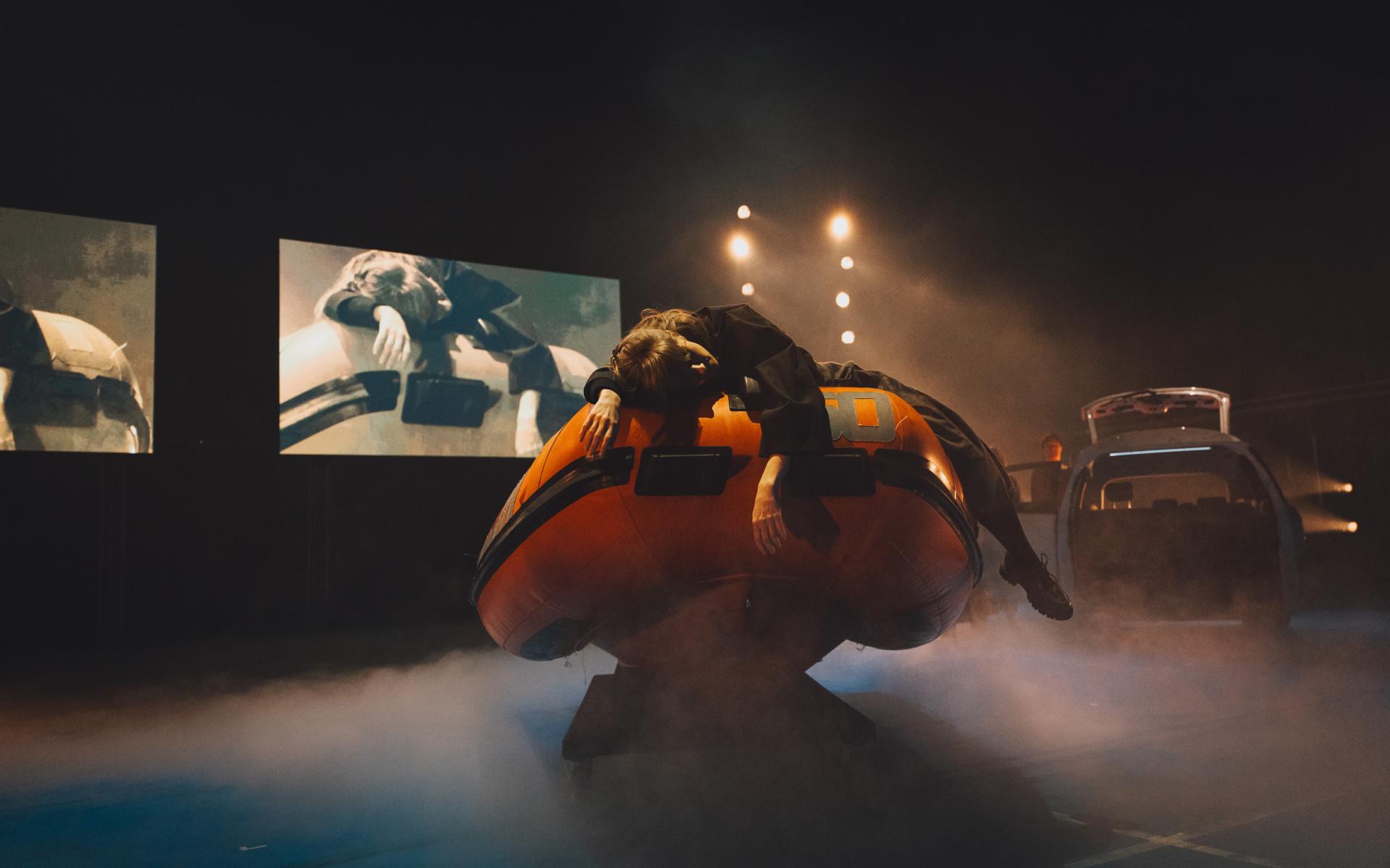
»The staging of Orpheus and Eurydice is grounded in strong thematic and reinterpretive emphases articulated in political and feminist terms; onstage, however, these are largely conveyed through a uniform lyrical register.«
Urša Majcen’s Orpheus and Eurydice is a metatheatrical and metamythological stage poem. Constructed as a flow of recurring motifs, it consciously renounces the dramatic representation of the myth. Formally, the text belongs to the field of postdramatic theatre, where it no longer functions as the vehicle for the development of action but rather as a means of establishing certain states, moods and reflection. It is designed as a lyrical-essayistic flow, constructed from repetitions, variations and metaphorical loops that persistently problematise the ideas of return, redemption and choice. The central feminist intervention into the mythological material shifts the focus away from Orpheus as a creative subject to Eurydice as the object of the myth, thus establishing a distinctly feminist critique of the imagery that reduces women to the roles of inspiration, companion or victim. Eurydice no longer appears in the text as the silent prize or the lost ideal, but as a speaking subject who does not wish to be reduced to mere material for Orpheus’s artistic sublimation. The introduction of Virginia Woolf, Sylvia Plath and Sarah Kane – authors whose deaths have been interpreted through the lens of personal pathology rather than through the structure of the world – extends the scope of the critique beyond the mythological framework and into a historical and systemic context. Their stories reveal how female suicide is interpreted from a male perspective, how their bodies have been canonised and how their authorship is often posthumously managed and controlled. In the production, the deaths of these authors mark the beginning of male guardianship over meaning, translating the myth of Orpheus and Eurydice into a broader question of the cultural appropriation of women’s lives and deaths.
The staging of Orpheus and Eurydice, directed by Jan Krmelj with dramaturgy by Petra Pogorevc, is grounded in strong thematic and reinterpretive emphases articulated in political and feminist terms; onstage, however, these are largely conveyed through a uniform lyrical register. The staging persists in a reflexive state with no distinct internal escalation or changes of rhythm, which makes it difficult to translate the conceptual precision of the text into a communicative theatrical event. The recurring mythological structure that the text establishes as a critical gesture – the realisation that one cannot simply escape the myth because it moves through different periods and contexts – is also adopted by the production at the level of form. Repetition therefore functions not as an object of conflict or reflection but as the dominant perceptual rhythm reinforcing the existing state of things rather than opening it up. It is precisely this overlap of content and form that establishes a paradox: that which is meant as a critique of repetition in the text is produced at the level of effect in the staging as a levelling of perception.
The performance space follows the textual framework, with an abstract, darkened set design. Set designer Lin Japelj recreates the mythological underworld as a space of in-betweenness, built from smoke and diffused light, saturating the stage with visceral intensity. On this basis, the deconstruction of the mythological story is layered across different performance levels: stage poetry, the actors as its bearers, collective stage movement, monumental set elements, the soundscape and video projections, which gradually riddle the mythological framework with references to contemporary social and political realities – from militarised violence and collective exhaustion to the disciplining of bodies and the objectification of women. In this way, the staging loosens the privileged point of view in an attempt to emancipate the viewer’s perception, which is no longer guided by a unified focus but rather spread across simultaneous perceptual registers. This division, however, more often produces dispersion than emancipation.
The actors (Nataša Tič Ralijan, Lena Hribar Škrlec, Matic Lukšič, Filip Samobor, Lara Wolf, Gregor Gruden, Joseph Nzobandora – Jose, Gal Oblak) do not function as bearers of a dramatic situation or as psychologically embodied subjects but as mediators of speech without the capacity for physical action. Their bodies are predominantly static, often almost motionless. Speech thus does not arise from bodily necessity; instead, it is expressed as a tapestry of sound. Such a division supports the lyrical nature of the text and speaks of a contemporary subject included in the system of representation but excluded from any real influence, while at the same time contributing to the overall static nature of the performance. The text is mostly reproduced onstage as a series of spoken thoughts rather than as a process unfolding in time and space, and consequently it often fails to reach the spectator.
On this basis, the performance also seeks to loosen the hierarchy of the gaze through the use of the camera and video projections (video designer Gašper Torkar). The simultaneous presence of live stage action and its enlarged, mediated image on the screens raises questions of perspective, distance and the relationship between truth and its digital reproduction. The meticuously framed film images are precisely executed and visually appealing, while the enlargement of bodies and faces allows for a more intimate insight into the stage action, which is often more suggestive than the view of a dispersed group of figures on the stage. The projection surface therefore quickly becomes the dominant field of perception, gradually absorbing the living bodies and functioning more as a spectacular, aesthetically appealing effect and less as a means of critically destabilising the gaze.
The choreographic language of Iztok Kovač, based on repetitive patterns of falling, twitching and collective movement, functions in a similar way. The dancers create an image of a multitude of subjects exposed to ideological structures and chronically trapped in their inability to act. In this way, they embody myth as a form of collective belief: the bodies persistently lowering to the ground evoke associations with devastation, exhaustion and violence, which refer to the contemporary reality of militarised violence in the world outside the myth. Yet because these movement patterns persist in a predictable rhythm, the choreography lacks a degree of dynamism. The music composed by Sašo Vollmaier follows suit, remaining predominantly atmospheric through its repetition of motifs, restrained harmonic shifts and plaintive vocal timbre.
In this context, the segment in which Eurydice’s voice expands and multiplies into those of Virginia Woolf, Sylvia Plath and Sarah Kane serves as a counterpoint to the entire performance. In the scene with Virginia Woolf, the abstract language, which in other parts remains at the level of an aesthetic state, is translated into a process that induces a perceptual shift in the spectator. The key element of this shift is Ajda Smrekar’s performance. She does not simply verbalise the poetic text but produces it in a way that anchors her diction in the body; the repetitiveness of the text thus does not level out the meaning but intensifies it, since each repetition carries greater internal pressure and more of what remains unspoken.
In dialogue with Ajda Smrekar’s performance, a strong choreographic and visual layer emerges: at an office desk, a dancer develops movement material composed of repeated falls and variations on the same pattern, abstracting the biographical references into the bodily experience of distress. The enlargement of the body on camera functions as an additional layer of perception, opening up the space for associative viewing. As an abstract visual composition, the scene gradually reveals new emphases and cracks by repeating the same motif, without fixing them in a singular meaning. From the spectator’s perspective, the text, the acting, the movement and the camera come together in an open-ended experience that triggers a process of theatrical thinking. This is precisely why the Virginia Woolf scene reveals that abstraction does not mean emptying and that dispersed attention is not emancipatory in itself but only becomes so when the perceptual material is sufficiently layered to allow the spectator the space for associative viewing.
In the Sylvia Plath scene, however, this strategy already becomes noticeably looser. The placement of the scene in a kitchen, directly evoking the circumstances of her death, is accompanied by the dancer’s more representational physical actions. The associative potential triggered by the multilayered abstraction in the Woolf scene is here enclosed within a recognisable sign. A similar thing occurs in the scene with Sarah Kane, where we are greeted by the image of a “hysterical” woman on a hospital bed: the intense bodily expression of her inner suffering quickly slides into illustration. Such images can be read as a conscious confrontation with the stereotypical view of the female artist as a pathological figure; however, the staging rarely sufficiently establishes a clear distance for the spectator to recognise this view as a construction rather than merely its repetition.
The text’s broader contemporary relevance is reflected precisely in this gap. Orpheus and Eurydice functions as a model of a world in which violence, loss and exhaustion no longer appear as exceptional events but as a permanent state. Critical discourse is omnipresent and reflection incessant, yet the possibility of rupture becomes increasingly elusive; stories of suffering are told and retold without significantly altering the power relations that produce them. Whether such a state can merely be thought or also overcome remains the crucial question that the production – despite all its limitations – raises today.
CONTACT @PRODUCERs (Ljubljana City Theatre): simona.belle@mgl.si, Head of Public Relations and Marketing; (Cankarjev dom): andrej.jaklic@cd-cc.si, Theatre and Contemporary Dance Programme Manager; (En-Knap): office@en-knap.com
Nika Arhar
An Invitation to Experience the World Differently
Bina Štampe Žmavc: The Chest of Blue Poppies. Maribor Puppet Theatre, première 5 February 2026, date of viewing 6 February 2026.

»Through the objects, their use and sound allusions /…/ the performance turns the inner landscape of the grandmother’s (altered) focus and experience outward; her personal reality is set up as the stage reality.«
In The Chest of Blue Poppies, Bina Štampe Žmavc tells the story of dementia, although she never uses the word and does not define the condition. Instead, she talks about the fields of oblivion that stretch all the way to the blue horizon and the lost words that the grandmother chases to get back, for which the grandfather makes a little chest, painted with blue poppies. Through poetic language and imaginative metaphors, the author unfolds for the reader a unique story of a grandmother and a grandfather that is both a fairy tale and a realistic story. Such an unusual world, spreading through the experiences of the grandmother, who is slowly losing her words and memories, and the grandfather’s careful support, also comes to life in the performance for children from the age of ten, which the director Ajda Rooss sets up as an intimate theatre of storytelling, imagery and soundscapes.
Within the main venue of the Judgement Tower, visual designer Darka Erdelji constructed a house-shaped framework representing the protagonists’ home and, at the same time, the space inhabited by the performer. The true setting and context of the story, however, are established by the entire visual, lighting and audio environment. The structure’s openness parallels the transition between the objective, external world and the subjective, experiential world, indicating the erasure of this division. Through the objects, their use and sound allusions (author of the music and sound designer Mateja Starič), the performance turns the inner landscape of the grandmother’s (altered) focus and experience outward; her personal reality is set up as the stage reality. The grandmother and grandfather’s home, filled with small everyday objects, is also a magical treasure chest of memories and associative and imaginative evocations: an interwoven network of the grandmother’s waning, atypical neurocognitive activity and the outlines of reality. Upside-down teacups hang from the ceiling, while old photographs pegged to a clothesline materialise the space of memory.
Subdued lighting with several small light sources and lamps (lighting design by Gregor Kuhar and Miljenko Knezoci), the objects of a slightly nostalgic nature and natural elements such as wooden branches representing trees, wooden components of the dwelling and small pebbles gathered to mark the path, establish a space evoking the embrace of a homely past and the transformed flow of time and understanding, as the everyday sounds of the world calm down and turn silent. As soon as Metka Jurc drops a few fluffy snowflakes over the row of trees in front of the house, the scene fills up with a symbolic echo of detachment, fields of silence, a slower rhythm and inner contemplation, thus reinforcing the atmosphere of altered perception and sensation and creating an environment that invites the spectators to immerse themselves in the inner sensation of the staged world, to connect on a level of sensory and intuitive perception and to get familiar with the presented perspective that is alien to everyday logic.
This convincing performative stance significantly enhances the overall atmosphere. Metka Jurc takes us through the disappearing and searching fields of the grandmother and the grandfather, and their caring, loving coexistence, with a calm, sensitive narrative voice. The story of the two small wooden puppet protagonists is interspersed with small but subtle staging interventions. When the grandmother gets lost and explains to the grandfather that it was actually the path that got lost – twisting, winding and running away from her until it turned into a proper maze – Metka Jurc visually renders the path’s mischievousness with the simple gesture of weaving a string through the dimly lit upper levels of the attic framework. In this way, she gives form to the grandmother’s perception of the path, a perception that prevents her from finding her way. As Jurc shifts into the protagonist’s mode of performance and emphasises individual gestures, animating the objects in the house, the lights and the soundscapes that extend the reality of the space, the grandmother’s subjectivity comes alive through poetic, magical and at times surreal touches. Here are memories of her youth and the “shoes of distance” with which the grandmother wishes to catch up with things receding into the distance, opening up the magical soundscape of a train carrying her to faraway places. There are also past experiences – if there is any difference between the two – in which the young grandmother and grandfather come to life through light, shadow and their portraits.
The raspberries that the grandmother picked for the grandfather are strung like pearls on a necklace, and fine sand pours out of the teapot instead of a liquid. The grandmother’s rustling beneath a tree connects her with nature and brings her closer to a form of life that is no longer entirely human, just as the sea of blue poppies merges with the blue sky. The scenes, the soundscapes and the objects in their actual use also reflect the metaphorical and symbolic meanings that co-form the thematic framework of ageing and transience. The passage of years and a person’s changing over time subtly raise the question of what actually makes up a person. When a person loses their words, their thoughts, their memories and their way, do they also lose themselves?
However, the staging perspective complements this loss with calmness in a concrete and broader sense. Here, loss is understood as a natural course of life and time, as part of the natural cycle, helping the spectator to accept it. Similarly, the grandfather anchors the grandmother as she drifts away from reality by accepting her unusual perceptions and explanations, while at the same time gently bringing her back into the reality of the moment and their shared life. The chest of blue poppies for the grandmother’s lost words is also the source of the magical blue light that sows a field of blue poppies, a symbol of their relationship representing love, care and the desire to understand and support the other in what they are and how they are.
The staging of The Chest of Blue Poppies – just as in the original picture book – offers a unique answer to the question of how to talk about dementia and age-related changes, as well as about old age, transience, memory and different forms of perception and being. Instead of a problem-based approach, the subtly composed world of the stage builds understanding through sensory experience. Compared to the picture book, the tone of this poetic and refined theatrical miniature is more serious. In the picture book, the poetically twisted thoughts and metaphors are balanced out by the humorously playful, colourful illustrations by Svjetlan Junaković and by some words in the text set in larger, bold letters. The performance thus requires a different kind of focus and attitude from the spectator. Through its tenderness and poetic quality, however, it also makes the sometimes challenging content more accessible. Perhaps a few more transitions from narration to fully staged solutions would make the magic more consistent. Yet the approach remains valuable. In a world where we are losing the sense for the other, just like the grandmother is losing her words, memories and the ability to orient herself in the world, the performance creates a space precisely for entering the inner world of the other and the different, perceiving them from their inner reality, in a direct and personal connection.
CONTACT @PRODUCER (Maribor Puppet Theatre): nika.bezeljak@lg-mb.si, Artistic Director
Ana Lorger
Comic Bits on the Life of Christ
Dario Fo, Franca Rame: The Comic Mysteries. Mladinsko Theatre. Première 26 February 2026.
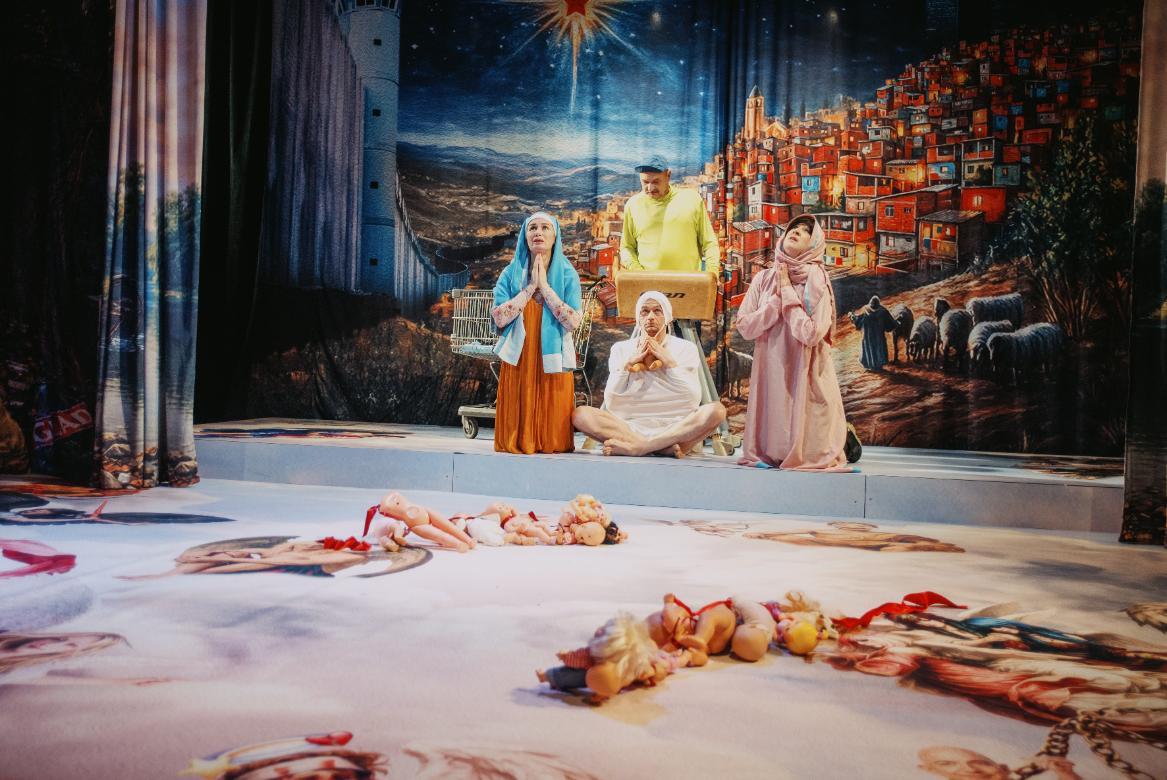
»Despite focusing on entertainment and light-hearted theatricality, The Comic Mysteries problematises certain aspects of contemporary capitalist society. The concluding story about the poor farmer who decides to fight for his rights takes the form of a parable, giving the production a didactic undertone.«
The play The Comic Mysteries (Mistero buffo) by the Italian actor, playwright and comedian Dario Fo and the actress and playwright Franca Rame is unorthodox in its very textual structure. As is typical of mystery plays, its dramaturgy is driven by a sequence of stations that follows scenes from the life of Christ. The authors accompany each scene with historical and contextual commentary and compare the scenes with contemporary class struggles in Italy. In the text, one can also find, for example, a suggestion that the actors should speak in dialect and that a single actress should play several characters. The drama describes in a comic and parodic manner various events connected to Christ’s miracles (the resurrection of Lazarus, the wedding at Cana), his birth and death (or rather crucifixion). Other stations portray Herod and his massacre of the newborns in Bethlehem, Pope Boniface VIII, and a poor farmer upon whom Jesus bestows the gift of speech and rhetorical skill.
Despite the authors’ suggestion, director Tijana Zinajić chose to cast several actresses and actors in the play’s roles, with each character rendered as a strongly defined theatrical type. The characterisation principle is reminiscent of the characters from commedia dell’arte, the actors embodying them by emphasised gestures, dialect, verbal peculiarities and the like. For example, through his Slovenian Prekmurje dialect and stooped posture, actor Dario Varga embodies a poor farmer or worker. Ivan Godnič in a wheelchair personifies Pope Boniface VIII, while Primož Bezjak uses the gestures of a child and a high-pitched voice to represent Jesus Christ. The characters’ features are emphasised, even exaggerated, giving the performance a comical edge from the get-go. The costume design reinforces this effect: Godnič is thus dressed as the pope, Romana Šalehar is dressed as Mary, and Primož Bezjak later changes his white nappies for clothes reminiscent of a hippie. All the actors perform these stylised characterisations consistently and with convincing seriousness, provoking outbursts of laughter from the audience. The dramaturgy of the stations is framed by the telling of stories that flows into performed scenes. The set design primarily consists of curtains with images that gradually open the depth of the stage space.
With self-referential elements and onstage alienation devices, the play constantly reminds us that what we are watching is a play within a play. At the beginning, the actors present themselves as a travelling group from the Mobile Mladinsko Theatre. Janja Majzelj plays the role of narrator, commentator and presenter, linking the scenes, while Katarina Stegnar serves as a commentator on political correctness. In this way, she intervenes in the sexist, xenophobic, ableist and ageist scenes and let the audience know that the creators of the performance are well aware of the problematic nature of the statements they speak on stage. In some scenes, the actors shift from playing fictional characters to playing versions of themselves, commenting on the creative process or revealing hierarchical relationships within the performance, a device that feels somewhat schematic at times. Otherwise, this principle, within the context of comedy, is strongly reminiscent of Trimalchio’s Dinner, directed by Bojana Lazić at Mladinsko Theatre almost five years ago. In that case, the trope of addressing hierarchical relationships in the theatre was brought to the forefront. External commentary on the fictional events on stage can also be inferred from the set design. The first curtain, depicting a 19th-century landscape, features a plastic Smurf, while the second, depicting Bethlehem, shows the wall Israel built in the West Bank, often referred to as the apartheid wall.
The alienation effect of external commentary on the contemporary situation can also be noticed in the music. In Brechtian fashion, songs accompanied by pianist Miha Rajterič build on and carry the scenes forward. Their melodies are often based on popular songs, while the lyrics are adapted to the action onstage. The performance thus invites us to immerse ourselves in the action through comical situations and acted scenes, while musical inserts and Katarina Stegnar’s and Janja Majzelj’s interventions into the stage action remind us that we are in the theatre. In this manner, the performance keeps the audience mindful of what they are actually laughing at, thus problematising the moral dimension of our laughter. Why does the sight of Boniface VIII in a wheelchair or the interaction between a blind man and a person with reduced mobility make us laugh? In some parts of the performance, laughter is thus accompanied by a bitter aftertaste.
The Comic Mysteries transforms the birth of Jesus, the depiction of his life and miracles and the consequent depiction of the relationship between rich and poor and good and evil into the genre of travesty. Through humour and comedy, it transforms the solemnity of the Bible and medieval mystery plays, drawing attention to the absurdity of the stories on which Christianity, particularly the Catholic faith, is founded. It is therefore not surprising that the Vatican condemned Fo’s Mistero buffo as blasphemous. Jesus is depicted as a naive child: his miracles serve his personal satisfaction and amusement solely, and his character resembles that of a mummy’s boy. His mother calls him Chris, and in one of the scenes other children even give him the nickname Palestine. In doing so, the production refers explicitly to the ideological dimension of Judaism, which, on the basis of the Bible, promises the Jewish people a land historically inhabited by an Arab population, the Palestinians, and thereby serves to justify the history of colonialism, imperialism, war and genocide in the region. In the production, the absurdity of the story of the birth and death of Christ exposes the mechanism driving the military industry of death and the global and class disparities that enable capitalism to function.
By using the story of a poor farmer who finds land that miraculously yields a huge harvest, the performance becomes even more directly political, as Jesus appears to the farmer and encourages him to resist the landlords and the rich, which he can do precisely through the gift of persuasive speech and good rhetoric. The scene is played by Janja Majzelj, who skilfully transitions from the role of presenter to that of the farmer. The story also articulates a clear political stance, calling for equality and the abolition of the poverty that the Church also helps to perpetuate.
However, through musical interludes and Katarina Stegnar’s commentary, which problematises political incorrectness, The Comic Mysteries also travesties the modern liberal credo, which often remains at the level of lip service rather than taking action. Despite focusing on entertainment and light-hearted theatricality, The Comic Mysteries problematises certain aspects of contemporary capitalist society. The concluding story about the poor farmer who decides to fight for his rights takes the form of a parable, giving the production a didactic undertone.
CONTACT @PRODUCER (Mladinsko Theatre): gasper.tesner@mladinsko-gl.si, Programme Coordinator
Evelin Bizjak
Whose Experience Counts as History?
Svetlana Alexievich, adapted by Špela Frlic: The Unwomanly Face of War. Slovenian National Theatre Drama Ljubljana, première and date of viewing 23 April 2026.
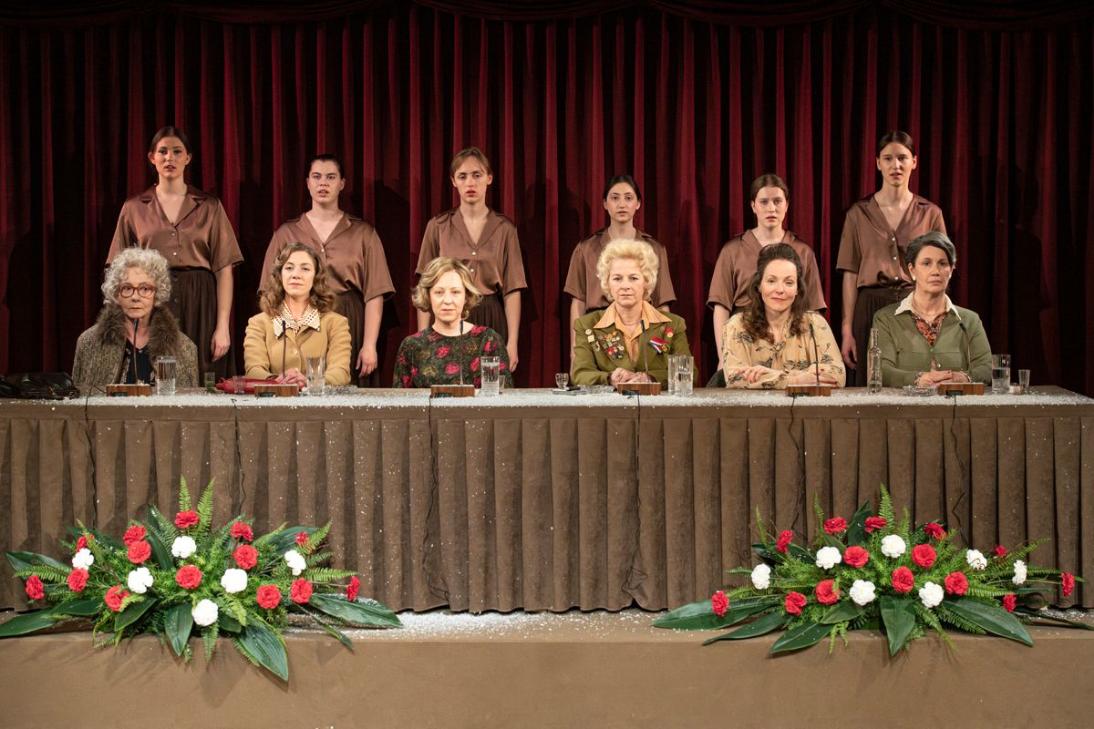
»The production is most powerful where it does not allow the women to slip into the role of victims, instead establishing their experience as an active, articulate and persistent presence.«
To view war through women’s eyes and put into words experiences that have no place in the historical record is the premise on which the production builds, with persistent faith in the power of the spoken word. Through fragments of testimony from women who left everyday life behind to enter the reality of war and had to learn to fight and kill, the text by Nobel Prize-winning Belarusian writer Svetlana Alexievich exposes war’s cruellest and often overlooked dimensions – with the aim of making war “that even the generals would be sickened by it”. The staging of Špela Frlic’s adaptation works in the same direction while preserving the original’s polyphonic structure. Using minimal theatrical means and without illustrating the violence, director Biljana Radinoska creates a space of concentrated listening. Rather than depicting war, the production translates it into an auditory and verbal experience: a multitude of voices whose presence has an impact of its own.
The dramatisation proceeds from a series of images that initially reproduce stereotypical notions of femininity before gradually transforming into images of women’s strength, solidarity and endurance on the battlefield. In addition to addressing the extremity of the historical situation, the testimonies shatter entrenched notions of gender roles and expose the fragility of the ethical and existential coordinates that determine individual action. The direction strives neither for an illusion of immediate authenticity nor for a spectacularisation of violence, but instead sustains the tension between what is spoken and what cannot be spoken, between the body that speaks and the form that shapes its speech. It is here that the production achieves its key effect: while powerful media images of violence often numb us, the spoken experience of pain, voiced in the presence of the bodies that bear it, has a direct impact without creating distance. The production thus problematises violence and its representation: how can we speak about something that has been systematically pushed out of the realm of shared memory, and what happens to it when it is finally given space onstage?
This tension is particularly evident in the spatial arrangement. The set design by Maruša Mali is based on strict frontality and the symmetrical composition of a long table, which clearly establishes the stage as a space of public testimony. The microphones, glasses of water and disciplined arrangement of bodies evoke a tribunal or press conference, where speech is both enabled and controlled. Within this institutional framework, a tension unfolds between the intimacy of confession and its formalisation. The red theatre curtain in the background operates ambiguously, both as a sign of theatrical representation and as a layer of historical memory imbued with ideological and violent connotations.
The minimalist staging does not imply impoverishment, but a deliberate removal of everything superfluous so that the articulated experience of those who have generally been excluded from public discourse can come to the fore. Positioning the women behind this long panel table is a powerful gesture precisely because it places them in a space that historically did not belong to them. The public platform, traditionally coded as a space of political action where history is shaped, is transformed here into a space of testimony in which personal experiences challenge dominant narratives. On the one hand, this scenographic decision rehabilitates the female voice as a bearer of history; on the other, it reveals the limitations of public space itself. The perceptual dissonance produced by personal experience in “public space” shows that content must be translated into an appropriate form if it is to be recognised as relevant. At the same time, it reveals how access to being heard is conditional and how personal experience must be disciplined, structured and expressed “officially” in order to become part of shared discourse.
Although the directorial choice of a predominantly static, frontal arrangement may seem monotonous, its restraint allows the text to cut through without distraction. At first, the actresses are clearly differentiated as the bearers of individual voices, but the production gradually shifts from individualised testimony towards a collective articulation of experience. In a choral structure in which speech is layered, fractured and rhythmicised, the production reaches one of its high points: the direct experience of war materialises as an auditory and bodily saturation that reflects the violence within the act of speaking itself, moving the battlefield from physical space into the realm of speech, where it becomes a struggle to be heard. At moments when the direction finds this kind of expressiveness, it demonstrates its ability to open up the content meaningfully through the form of the staging. We therefore sometimes wish that this formal logic permeated the work more consistently. Another effective moment comes when the production shifts into a more overtly theatrical mode and the protagonists, caught up in the moment, come together in a shared fantasy of the future after the war. This lightness functions as a brief projection of desire, revealing the need for normalisation and a return to pre-war life scenarios. This is precisely why its place within the whole is so important: when the production closes once again into the frontal form of testimony, a sharp divide emerges between the imagined future and the subsequent experience, which once more binds the women to normative images of femininity.
The actresses (Iva Babić, Barbara Cerar, Silva Čušin, Vanja Plut, Eva Jesenovec and Maja Sever) wear military uniforms, placing them directly within the symbolic space of power, history and the institution. The uniform, traditionally a bearer of male heroism and collective memory, is here reinscribed on bodies that have been excluded from this narrative. The production thereby establishes an important shift at the visual level: women no longer stand outside history but at its centre (costume design: Jelena Proković). The performers maintain a slightly elevated, partly aestheticised mode of speech that follows the novelistic, polyphonic nature of Alexievich’s text. By moving away from psychological realism, the production foregrounds the articulation of testimony as form and approaches the principles of documentary theatre, in which authenticity bypasses the illusion of identification while remaining suspended between personal material and its public expression.
Yet this formal decision is not carried through consistently. At the same time, the actresses develop recognisable individual registers, characterisations and emotional states that intensify over the course of the performance. Rather than establishing a clear acting principle that distinguishes between bearers of voices and staged figures, the production creates an intermediate space in which the acting is neither wholly impersonal nor fully developed in psychological terms. This decision has a double-edged effect: on the one hand, it prevents a slide into sentimentality; on the other, the very restraint sometimes creates a sense of distance, since the body and voice, while maintaining a layer of controlled speech, never become fully permeable to the material. Yet it is in this gap that the key tension emerges. Rather than witnessing trauma being relived directly, we watch its containment and verbalisation as a process that constantly hovers at the boundary between the need for articulation and its inherent inadequacy. The weight of the (un)spoken thus emerges through the performers’ handling of the material: silences, pauses and repetitions create a subtext in which the effort of narration becomes visible.
The production is most powerful where it does not allow the women to slip into the role of victims, instead establishing their experience as an active, articulate and persistent presence. Although it exposes the mechanisms of erasure and marginalisation, it avoids reproducing them and even transcends them: the women do not remain trapped in the shadow of history, but through the very act of speaking re-establish history as a space they can actively enter. In this sense, The Unwomanly Face of War functions simultaneously as critique and affirmation, creating a space in which experience does not seek legitimacy from outside but establishes its own.
CONTACT @PRODUCER (Slovenian National Theatre Drama Ljubljana): drama@drama.si
Katarina Bogataj
Constraint as a Compositional Condition
Anamaria Klajnšček: Vulneri. Pekinpah and En-Knap. Španski borci, 7 February 2026.
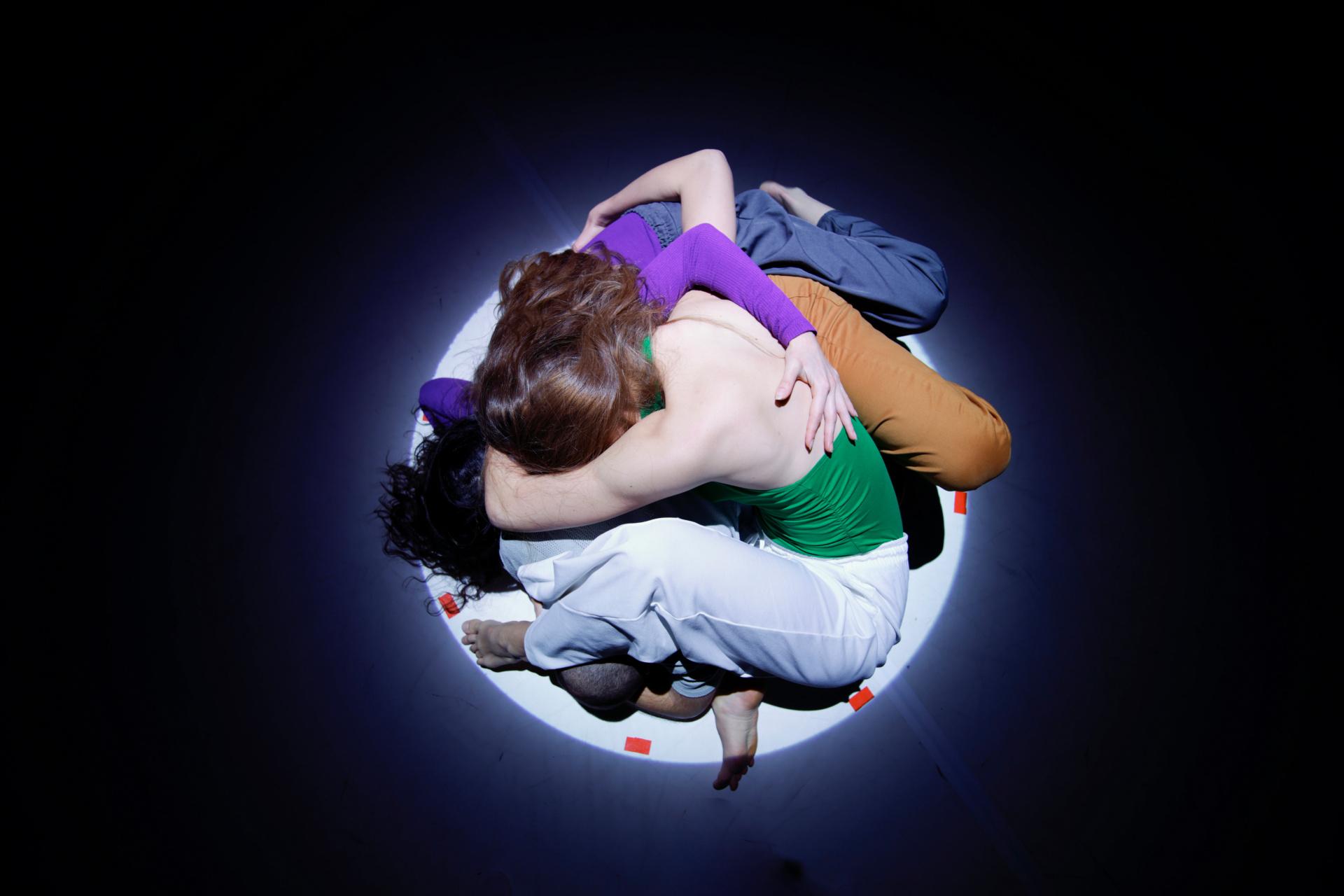
»According to the creative team, Vulneri “explores freedom through the impossibilities that define it”. We understand from this that the constraints are imposed deliberately, in the knowledge that the results will inevitably be somewhat predictable.«
In a clearly bounded pool of light, three bodies with different physical and movement characteristics find themselves in forced proximity. The creative team behind Vulneri set themselves a considerable challenge: how to stage the trio’s entire action within a space defined by a single spotlight, which in itself constrains the range of possible movement. Nevertheless, we gave ourselves over to the anticipation of where their exploration might take us.
As we took our seats, the dancers were already moving freely and fluidly within the spatial constraints, filling the gaps as though exploring every cell available under the circumstances. They spoke quietly, laughed and murmured to one another, their inward-facing communication distancing them from the audience. When the lights illuminating the auditorium went out, and attention shifted to the stage, the murmuring ceased, and the performance officially began, although the movement task itself remained unchanged; the transition from informal interaction to performance was therefore left unresolved.
All three dancers – Anamaria Klajnšček, Beno Novak and Krystýna Peldová – are experienced improvisers (one need only mention the series Konstelacije and Neforma) and possess an exceptional instinctive sense of a scene’s duration. This sensibility is also evident in the present work, which combines structured improvisation with set material. We register a change only once we are already deep into the next section, while each new set of conditions also alters the quality of bodily presence. In one situation, for example, the bodies coordinate as they search for empty spaces; in the next, their relationship tips into a struggle for space. Movement becomes tense and competitive, breathing quickens, and the narrowing spotlight visually reinforces the sense of claustrophobia. By the third transition, we perceive the production’s structure: a succession of frames, each generating its own circumstances and directing both the movement and the audience’s perception. The costumes follow the movement. Their uniform colour palette suggests an interwoven, almost collective body, while their distinct silhouettes and emphasis on the performers’ physical differences preserve individuality, creating a visual state poised between connection and separation. The music likewise functions not merely as accompaniment but as an autonomous element of the staging, a quality further emphasised by the placement of pianist Tine Grgurevič – Bowrain within the performance space (we have our first real opportunity to see his elaborate, entirely black costume only during the curtain call).
The mode of movement is also reflected in the establishment of a situational hierarchy; for a moment, it becomes crucial who occupies the centre and who assumes a supporting role. When the tension among the dancers is exhausted, and the struggle offers no further way out, Peldová emerges as a character. The production shifts out of its established register and becomes a depiction of her inner world, which moves beyond the prescribed physical constraints. The introduction of this inner dimension raises the question of spatial layering: space is not merely a material given but also exists as a subjective dimension. In a kind of vertigo, Peldová repeatedly reaches beyond the spotlight while the other two bodies try to hold her back. The word bodies is deliberate here: the other dancers do not develop sufficient characterisation to stand alongside the figure of Peldová, remaining primarily functional elements of the scene. The scene ends when Klajnšček lifts Peldová onto her shoulders, and the music falls silent. Peldová looks around as though a magnificent vista had opened before her, then lowers herself back to the floor. The character emerges only in this scene; once it has served its function, it disappears as though it had never existed.
Without this insertion, Vulneri could readily be conceived as a sequence of situations without cumulative effect: the performers would carry no trace of previous decisions, changes would occur for their own sake, and each episode would effectively begin anew. In that case, what we see could be compared to Simone Forti’s task-based works, in which meaning arises not from a traceable progression of changes or psychological continuity but from the performance of the tasks themselves. The tasks do not produce meaning directly; instead, they establish conditions that call for a material reading of the bodies – risk, fatigue and so forth. There are no hidden meanings, while the absence of development becomes the principle that determines structure, duration and perception.
In the production under discussion, however, the introduction of a narrative scene creates a rupture, shifting the established plane onto a metaphorical level and moving beyond the initial premise. This shift would not in itself be problematic if the development continued and visibly affected the performers’ relationships. Instead, the narrative episode has no discernible consequences for those relationships. It creates the impression that the production has not decided whether it wants to retain this discontinuity or suggest a deeper meaning. The relationships established by the narrative moment are neither thematised, reflected upon nor deepened by the end of the production, and it is here that the differences among the performers at the level of dramatic expression become apparent.
The following sequence returns to the initial level of structured improvisation, or the execution of tasks: lifting one person, climbing over one another and forming tiers. In the passage of open improvisation, we recognise the dancers’ distinctive styles, ranging from quick, subtle gestures to body extensions and more technical movements. As a concluding gesture, all three reach beyond the bounded space, using lifts to extend above it, before the lights gradually fade – an element already integrated into the performance material.
According to the creative team, Vulneri “explores freedom through the impossibilities that define it”. We understand from this that the constraints are imposed deliberately, in the knowledge that the results will inevitably be somewhat predictable. Given these impossibilities, one might say that the production is really asking: what can surprise us at all? Beyond the spatial restriction, no distinct choreographic research is evident. The structure draws on familiar movement idioms and tasks, while the dynamic among the performers is largely collaborative, perhaps even neutral. The combative and narrative-metaphorical moments briefly sharpen the relationships but do not affect how the production ultimately unfolds.
Technically, the execution is exceptionally precise: the dancers are highly attuned to one another and respond in a coordinated manner within the space. At certain moments, however, a more pronounced dimension of conscious presence is lacking, while the sections foregrounding individual qualities call for clearer characterisation. The subtle level of narrative authority at which the body knows rather than merely shows is not consistently present. It might be established if the tasks were interpreted according to the inner logic of a conscious response to the space and to the energy and intensity of the participants. Such an approach would further strengthen the sense of presence and open up space for spontaneous reactions. The audience could then observe conditions being established in real time, conditions that would, in themselves, function narratively and, at times, prove unpredictable. To some extent, we are left with a sense that the stage action is closed off and determined from the outset. When we reflect on the work as a whole, the lasting impression is that we ourselves supply meaning where the compositional framework does not explicitly determine it.
CONTACT @PRODUCERS (Pekinpah): posta@pekinpah.com; (En-Knap): office@en-knap.com
Nika Šoštarič
On Transience: What About Self-Critique?
Self-critique as a methodological tool: an analysis of the gap between intention and realisation

»Based on the argument, we can therefore conclude that self-critique of a performance work is not merely a retrospective reflection on the success or failure of an artistic project. It is a methodological and discursive process that enables the transformation of an ephemeral performance event into an object of analysis, thus opening space for the production of a specific form of artistic knowledge.«
A FEW WORDS BY WAY OF INTRODUCTION
At the academy, Professor Blaž Lukan often explained to us how some critics would sometimes rush home immediately after seeing a performance and stay up all night typing, so that in the early hours of the morning they could run to the editorial office with their review still warm and have it published in the newspaper. And how the creators of the production would be on tenterhooks to know what the newspaper review would say before they even brushed their teeth. All of this happened in a single night (let’s say, within 24 hours). In that sense, theatre criticism also served as a kind of promotional device, a marketing tool for the theatre. Based on these initial reviews and reports, newspaper readers decided whether to devote their time to a particular performance. It all sounds quite romantic, doesn’t it?
And then you think about today, when, with the almighty internet, we do not have to wait until the next morning for the reviews; instead, they could (hypothetically) be available before bedtime. In reality, however, the situation is exactly the opposite. Creators sometimes have to wait for weeks for anything to be published. If there is anyone to write a review at all. Meanwhile, everyone has already forgotten about it, and theatres run their marketing campaigns regardless of the critical response. Even if a performance gets an unfavourable review, how many people will actually read it and decide on that basis whether to see the production? Statistically, the vast majority of theatre criticism concerns institutional theatre productions in Ljubljana, followed by the Ljubljana non-institutional scene. Occasionally, you can find a review from Maribor… and then slowly it peters out. Of space? Of time? Of interest? Thus, a large number of (in other words, too many) performances go without receiving a critical response. So now what? Will we, the creators, have to start writing our own reviews? The answer is both yes and no; however, that is not the main purpose of the self-critique of a performance work, which functions not merely as a means of historicising or reflecting on the artistic process but as a methodological procedure that transforms the transient performance event into an object of analysis.
A performance work is ephemeral by its very nature, and there is something very beautiful in this, yet at the same time very sad. An event, a happening which evaporates from reality more vividly than anything else around us. But since transience is the main characteristic of being (a)live, this means that the event or the happening is always already a thing of the past; something that will never again be. Of course, there are subsequent performances, but it can never happen again with the same context, at the same time, in the same place, with the same reception. A performance, therefore, does not merely face an ontological problem and various terminological difficulties but also many open epistemological questions. How to archive something that no longer exists? How to pass on its memory to future generations?
Today at the Louvre, we can still see the same Mona Lisa painted in the early 16th century. Yet, we cannot witness Marina Abramović and Ulay’s works of performance art with the same degree of reality. Yes, of course, there is something: there is material evidence (costumes, props, set design), audiovisual material, written records (reviews and the artists’ notes), living memories and reconstructed performances (for example, Katarina Stegnar and Primož Bezjak, who are currently reproducing their performances as part of the Art Vital exhibition). But all of these are merely approximations – limits that can never attain the original, pure reality. How, then, can a work of art that has already happened become the subject of systematic analysis and critical reflection?
WHAT EXACTLY IS SELF-CRITIQUE?
One way of addressing this problem in contemporary artistic practice is through self-critique of a performance work – a retrospective analytical practice in which creators reflect on their own artistic decisions, procedures and the effects of the work performed. We can situate this practice precisely at the intersection of artistic practice and theoretical reflection. On the one hand, it derives from the creators’ internal perspective, which provides direct insight into the process of creating the work, its conceptual premises and production circumstances. On the other hand, it requires a distance, as the performance, once concluded, transforms from a creative act into an object of analysis. In this sense, self-critique is not merely a personal reflection or description of the process, but rather a structured critical practice that attempts to articulate the relationship between artistic intention, the structure of the performance and the reception of the work. This way, the performance event no longer exists merely as an aesthetic experience, but also as a field of knowledge production.
Self-critique thus becomes a methodological instrument, an analysis of the gap between intention and realisation. A performance work, however, is always the result of a complex network of factors – artistic decisions, the bodily praxis of the performers, spatial conditions, technological constraints and audience reactions. These elements can produce meanings and effects that go beyond or even contradict the original artistic concept. Self-critique enables creators to identify unforeseen dimensions of their work and incorporate them into subsequent interpretation. This way, after the performance ends, it does not become merely a concluded event, but a starting point of a secondary process of understanding and reinterpretation. There is, however, a catch: how can an artist critically analyse their own work without the reflection turning into a subjective rationalisation or retroactive legitimisation of artistic decisions? If at all?
METHODOLOGY
If self-critique is to transcend mere subjective commentary and become a productive theoretical tool, it must be grounded in a specific methodological framework that structures reflection as an analytical process. The methodology of self-critique thus includes several interrelated steps that enable a systematic examination of the performance work after it is carried out.
Step one: reconstruction of the creative process. This phase involves analysing the initial conceptual starting points, research questions and artistic intentions that led to the artwork’s creation. It is also important to understand the production conditions that shaped the creative process, such as time constraints, spatial constraints and collaboration among different creators. Reconstructing the process allows the performance to be understood as the result of a specific network of decisions and circumstances that influenced its final form.
Step two: analysis of the structure of the performance itself. In this phase, attention must focus on the performance’s formal and dramaturgical elements. The analysis may include the organisation of time, the use of space, the physical practices of the performers, the relationship between speech and movement and the ways of establishing relationships with the audience. The purpose of such an analysis is not merely to describe the course of the performance, but to understand how certain aesthetic strategies create specific meanings and affective effects.
Step Three: comparison of the artistic intention to the actual effect of the work. In performance-based art, the relationship between intention and realisation is often complex and unpredictable. Interactions with the audience, spatial conditions and elements of improvisation can yield results that differ from the creators’ original expectations. Self-critical analysis seeks to identify these differences and consider how they influenced the final perception of the work. In this context, analysing audience responses, critical reviews, or performance documentation can also be useful.
Step Four: Reflection on the creative methods. A performance project often involves specific research or creative processes, such as improvisational methods, collective dramaturgy development, and so on. Self-critique allows us to analyse and evaluate these methods in retrospect. Such reflection can reveal which strategies proved productive and which may have hindered the work’s development.
Step Five: contextual analysis of the performance. The performance work thus becomes situated within a broader artistic, social and institutional framework, thereby reflecting specific aesthetic traditions, responding to current social issues, or problematising the conditions of artistic production. A self-critical analysis can reveal how these contexts influenced the creation of the work and how the work itself intervened in the existing discourse.
PITFALLS AND FUNCTIONS
Although self-critique is an important reflective tool for analysing artistic practice, it also involves several caveats stemming from the fact that the author serves as their own critic, i.e., both the subject and object of criticism. The most obvious trap in self-critique is therefore the problem of subjectivity. Since the creators themselves conduct the self-critique, there is a danger that the reflection becomes primarily a rationalisation of their artistic decisions. The artist may subsequently interpret their work in a way that justifies their decisions, rather than actually problematising them. In this case, self-critique does not function as criticism but rather as a means of legitimising existing procedures.
Another pitfall lurks in the relationship between the artist’s intention and the interpretation of the artwork. Self-critique often stems from the artist’s understanding of their own project; however, a performance work, by its very nature, transcends individual intent, as meaning is formed through interaction with the audience, the space and the broader cultural context. When artists analyse their own work, there is a danger that they assume a privileged position in their interpretation, thus limiting the plurality of possible interpretations.
The third trap of self-critique concerns temporal distance. Reflection following a performance necessarily takes place retrospectively. This means the artist interprets the event through memory, documentation and subsequent reflection. This process can lead to a reconstruction of the event that diverges from its actual experience. Selective memory highlights some elements while suppressing others; thus, self-critical analysis always involves a certain reinterpretation of the performance event.
Despite these limitations, self-critique is still an important element of contemporary artistic practice, especially in contexts where external art criticism is often weakened or fragmented. One of the key functions of self-critique is therefore to sustain critical discourse on artistic praxis. When external criticism can no longer provide space for in-depth analysis, as it is limited to brief responses or promotional formats, artists themselves can contribute to the development of a reflective discourse that transcends mere promotion or interpretation. Self-critical writings enable insight into creative processes, reveal working methodologies and raise questions that external criticism often cannot address, as it lacks direct access to the creative process.
Another important function of self-critique is the articulation of implicit knowledge emerging in artistic practice. A large part of creative work is based on intuition, bodily praxis and situational decisions that are difficult to conceptualise directly. Self-critique allows this knowledge to be reflected upon and structured into a discursive form. This way, artistic practice produces not only aesthetic objects or events, but also specific forms of insight into the modes of creation.
Furthermore, self-critique enables critical reflection on the artist’s position within the art system. Artistic production is always embedded in a network of institutional, economic and cultural conditions. A retrospective analysis of a project can reveal how these conditions influence the creation of the work and how the artists themselves participate in these structures. In this sense, self-critique is not directed solely at the aesthetic dimension of the performance, but also at a broader understanding of the artistic field. In a contemporary context, where the conditions for artistic production are often unstable, and the space for systematic critical reflection is shrinking, self-critique thus becomes an important tool for preserving the reflective dimension of artistic practice. Although it cannot replace external criticism, it can serve as a complementary element and as a means for artists themselves to contribute to the development of theoretical and critical discourse on contemporary art.
EXAMPLE 1: SIMONA HAMER
As a concrete example of self-critical analysis of a performance work, let us consider the text “Self-Critique: What We Expected and What We Got While Waiting”, by Simona Hamer. The text is available on the SiGledal portal as a self-reflection on a project in which the author participated in a series of performances both as a creator and an observer of her own work. In her self-critique, Hamer first reconstructs the context of the project’s creation and the reasons for its conception. In doing so, she begins with the question of expectations – what the initial idea of the project was promising and what actually happened through the process and its realisation. This approach corresponds to the first methodological step of self-critique, namely, the reconstruction of the creative process. The artist reflects on the dynamics of creative work, collaboration and the gradual development of the performative structure. Thus, the performance does not appear as a stable object, but rather as the result of a series of decisions, experiments and changes.
Since she was also involved in these performances as a performer, her self-critique focuses on the experience of physical presence on stage and on the relationship between individual and collective creation. The author thus reflects on how relationships among different creators form in a performative situation, how expectations shift within the process and how artistic decisions materialise in a concrete performance. Simona Hamer’s self-critique goes beyond mere description of the project and becomes an analytical commentary on the nature of performative creation. Her text demonstrates that self-critique can serve as a method of reflection on artistic processes, revealing the mechanisms of performance-making and problematising the relationship between the artistic idea, collective work and the finished performance. This example demonstrates that self-critique in contemporary performance-based art is more than a retrospective commentary on a work’s success or failure; it can also function as a reflective discourse that broadens our understanding of artistic praxis and enables the articulation of implicit creative processes.
EXAMPLE 2: NIKA ŠOŠTARIČ (OR AN ATTEMPT AT SELF-CRITIQUE)
As part of the 4th Performative Day (at UL AGRFT), I performed the informance All My Little Deaths, which I repeated three times in one day. In connection with this, I also prepared the installation Cartography of Fear. The latter served on the one hand as separate material evidence, a trace, for visitors who were unable to attend the performance event itself. On the other hand, it also complemented the performance, establishing the atmosphere and serving as a document of the time. In the format of a travelogue lecture, based on materials from my own solitary backpacking trips through the United States and Indonesia, I incorporated my thoughts and the challenges I experienced while travelling and later reflected on at home in Ljubljana. I talked about menstruation, which limits both travelling and theatre practice; how pads are not a given; how (not) to trust strangers; and, in general, how to survive, since all is not always sunshine and roses. However, that is precisely why one must persevere all the more. Because we can. Because we are able to. Because I am still more afraid of the things that could happen to me in Slovenia than on the other side of the world. Thus, using a curatorial method of collecting ready-made material, I connected and created a story that was new and old at the same time.
The context and impetus for my performance were thus the occasion of the performative day on which other Academy students presented their installations and performances as well. This is connected also to the conditions of production, such as the date and time of the performance, the venue, the budget and, of course, the target audience (students, professors, theatre professionals, as well as students from the Performing Arts Grammar School and, to a lesser extent, the general public). The intention of my informance was a kind of reflection, report and sharing of the feelings concerning various events that weigh on all women who experience menstruation. For even though we are well into the 21st century, many topics are still either taken for granted or considered taboo. My performance thus sought to encourage open discussion of the female body without secretive codes such as “aunt Flo is visiting”, while at the same time opening a direct dialogue with the audience (both in the theatre and outside it).
How about the effects? While writing this very part of the text, I got stuck myself. I felt the pitfall that I mentioned above firsthand. So how can I explain to readers that, in my opinion, I achieved the effect fully without it coming across as self-praise? Perhaps by mentioning the moments that are as objective as possible? For example, after each of the three performances, several audience members approached me to share their own stories and experiences. I received a lot of feedback from high school students who, even a week after the event, were coming up to me to tell me they had been reflecting on the performance long after it ended. Furthermore, perhaps this doubt about subjectivity is the real reason I am writing this article on self-critique and taking matters into my own hands. Or something along those lines.
CONCLUSION
Based on the argument, we can therefore conclude that self-critique of a performance work is not merely a retrospective reflection on the success or failure of an artistic project. It is a methodological and discursive process that enables the transformation of an ephemeral performance event into an object of analysis, thus opening space for the production of a specific form of artistic knowledge. In this process, performance-based art functions not merely as an aesthetic practice but also as a reflexive field in which creation, analysis and criticism intertwine. And at a time when external criticism is in crisis, self-critique may at least be a temporary solution for preventing ephemeral art from disappearing without a trace.
Although I write about performance events in this text, such a method can also be applied to other forms of creation. What systems do dramaturgs choose for analysing dramatic texts? How do directors develop staging concepts? How are project meetings managed inside institutions? How is production work planned? How does Beton Ltd. operate? And last but not least, how does Simona Semenič write her texts?